-
E-mail
sales01#gzyuli.com,sales02#gzyuli.com(发邮件时,请将 # 修改为 @)
-
Phone
15917453768
-
Address
Room A309, No. 22 Guanyu Road, Tangdong, Tianhe District, Guangzhou City, Guangdong Province
Product Categories
Guangzhou Yuli Electronic Technology Co., Ltd

Sigma optical near ultraviolet objective lens
NegotiableUpdate on 01/28
- Model
- Nature of the Manufacturer
- Producers
- Product Category
- Place of Origin
Overview
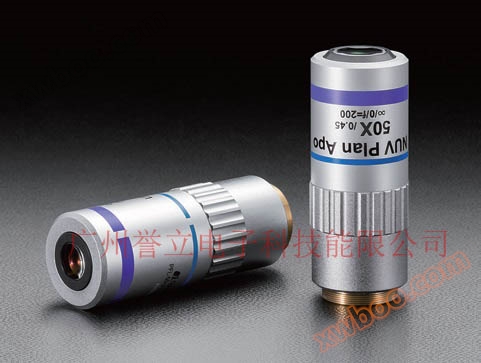
Sigma optical near ultraviolet objective lens
Product Details
Product Introduction
objective lensThe working distance (WD) is long, the field curvature is also corrected, and natural and clear observation images can be obtained at the edge of the field of view.
It can be used for coaxial observation systems or laser guided optical systems, and is an infinitely far corrected objective lens.
It can also be used for observing near ultraviolet and infrared light.
This mirror can also be used for visible light (532nm) pulsed lasers.
Laser damage threshold (reference value) 0.05J/cm2(355nm),0.1J/cm2(532nm)
(Pulse width: 10ns, repetition rate: 20Hz)
information
▶ Equipped with a fixed objective lens holder (LHO-26).
▶ If you need to fix the objective lens on the cross motion bracket, please consult the sales department.
▶ When used as a laser processing objective lens, our company also supplies coaxial illumination observation units (OUCI-2) and laser introduction color separation prisms (DIMC).
▶ If you wish to customize an objective lens with a thinner glass cover, please feel free to inquire.
Attention
▶ When using the objective lens for laser processing, please adjust the diameter of the incident beam (1/e)2)Used when expanding to about half the pupil diameter. When the incident beam is too thin, a very small focused spot cannot be obtained, and the energy density of the laser will increase, which may also damage the objective lens.
▶ When using an objective lens for laser processing, the powder splashed during processing may contaminate the mirror surface of the objective lens. Please ensure sufficient working distance (WD) or insert thin protective lenses to avoid dirtying the objective lens.
▶ The magnification is the value when using an imaging mirror with f=200mm. When using imaging mirrors from other manufacturers, the magnification may be different. Firstly, it is necessary to confirm the focal length of the imaging lens used, and calculate the actual magnification based on the ratio of the focal length of the imaging lens to the focal length of the objective lens.
Outline drawing


Transmittance wavelength characteristics (reference data)

Similar Product Recommend


