-
E-mail
578736503@qq.com
-
Phone
18092609686
-
Address
No.7 Xingang 3rd Road, Northwest Furniture Industrial Park, Huaxu Town, Lantian
Product Categories
Xi'an Yongxing Food and Pharmaceutical Machinery Co., Ltd

Solid state vinegar brewing equipment and its brewing process
NegotiableUpdate on 09/18
- Model
- Nature of the Manufacturer
- Producers
- Product Category
- Place of Origin
Overview
Solid state vinegar brewing equipment and its brewing process. Solid state fermentation method is used to brew vinegar by utilizing wild microorganisms in nature, so the fermentation cycle is long, and the fermentation of acetic acid requires flipping the mash, resulting in high labor intensity
Product Details
Solid state vinegar brewing equipment and its brewing process
The solid-state fermentation method for making vinegar utilizes wild microorganisms in nature, resulting in a long fermentation cycle and the need to flip the mash during acetic acid fermentation, which is labor-intensive. Alcohol fermentation is carried out on yeast, followed by pure cultivation of acetic acid bacteria to produce vinegar yeast, which is then fermented with acetic acid to produce vinegar. There are also methods that use enzymatic liquefaction, ventilation, and reflux. After soaking the raw materials in water and grinding the slurry, bacteria are first addedalpha-Starch enzyme is heated and liquefied, then wheat bran is added for saccharification. The saccharification mash is cooled, and yeast is added for alcohol fermentation. After the alcohol fermentation is complete, the mash, bran, rice husk, and vinegar are fully mixed and sent to an acetic acid fermentation tank with a false bottom. There is a ventilation hole under the false bottom to allow air to enter naturally. Natural ventilation and vinegar reflux are used instead of turning the mash, and the temperature of the vinegar mash is uniformly fermented until it matures. The yield, vinegar yield, and labor productivity of the enzymatic liquefaction ventilation reflux method are higher than those of the traditional method.
Solid state brewing mainly includes the following equipment
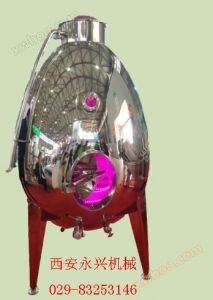
Steaming pot, fermentation tank (fermentation pool), mash turning machine, vinegar pouring tank, storage tank, sterilizer, filter and blending tank, etc.
The traditional solid-state fermentation vinegar brewing process mainly includes the following3plant
1Using Daqu to make vinegar: Using sorghum as the main raw material and enzymes secreted in Daqu, low-temperature saccharification and alcohol fermentation are carried out. Half of the mature vinegar mash is placed in a fermentation tank and heated over low heat. After the fermentation is completed, the other half of the mature vinegar mash is soaked in vinegar solution, and then new vinegar is poured out. Finally, the new vinegar is aged through a process of sun drying and ice harvesting for three months and one winter Made into vinegar with a black brown color, thick texture, mellow acidity, and special aroma.
2Using koji to make vinegar: Using glutinous rice and rice as raw materials, first use microorganisms such as Rhizopus and yeast in koji to conduct solid-state cultivation on rice grains, and ferment while saccharification. Add water and koji, continue saccharification and alcohol fermentation. Then, the mash is mixed with bran to form a solid state and placed in a vat. High quality vinegar mash is added as seeds, and solid-state layered fermentation is used to gradually expand the growth of acetic acid bacteria. After aging with vinegar, the vinegar juice is poured out using a drizzle method, mixed with stir fried beige and white sugar, clarified, and heated to boiling to obtain fragrant vinegar. Of course, there is Zhenjiang vinegar.
3Using bran as the main ingredient, vinegar mother is made by adding glutinous rice with wine or polygonum juice for acetic acid fermentation. The vinegar mash is aged for one year to produce a unique flavor of bran vinegar.
Solid vinegar process flow
Similar Product Recommend