-
E-mail
289239104@qq.com
-
Phone
13761118616
-
Address
Shanghai Minhang District Duhang Construction Municipal Engineering Co., Ltd., No. 3259 Shendu Road, Minhang District, Shanghai
Product Categories
Shanghai Rongjida Instrument Technology Co., Ltd


YYW-1 lime soil unconfined pressure gauge Shanghai Rongjida
NegotiableUpdate on 03/12
- Model
- Nature of the Manufacturer
- Producers
- Product Category
- Place of Origin
Overview
1、 Product Introduction: Lime soil unconfined pressure gauge is a detection instrument
Product Details
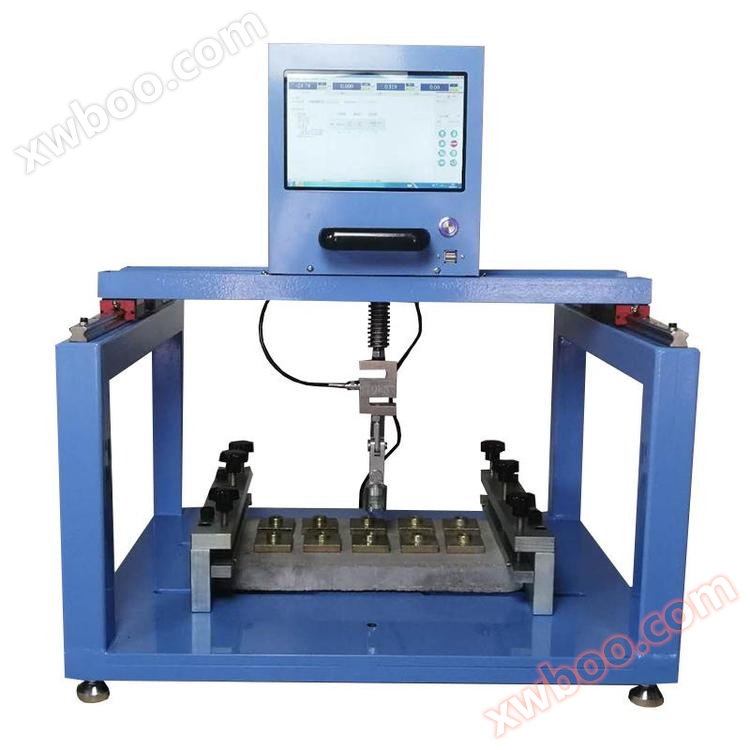
1、 Product Introduction:The unconfined pressure gauge for lime soil is a testing instrument. Used to determine the unconfined compressive strength of soft clay with high saturation, which is subjected to axial pressure under unrestricted lateral conditions until the specimen is damaged. Meanwhile, the unconfined compressive strength test is also used to determine the sensitivity of soil. The sensitivity is the ratio of the unconfined compressive strength of undisturbed soil to remolded soil that maintains its natural moisture content.
2、 Technical indicators:
★ A large load: 5KN
★ Manual ascent speed: 18 turns/1mm
★ Screw disc diameter: Ø 52mm
★ Screw movement distance: 50mm
★ Test piece size: Φ 50X50 Φ 50X100
★ Weight: 40kg
★ Dimensions: 600x50x800 (mm)
3、 Test method:
★ Place the undisturbed soil on the table in the natural layer direction, use a soil cutter or steel saw to cut into soil columns with a diameter larger than the sample, and place them between the shang xia discs of the soil cutting disc. Then, use a soil cutter or steel saw to carefully cut along the side plate from top to bottom, while rotating the disc until it reaches the required height. Remove the sample, flatten both ends according to the required height, and the end face should be flat and perpendicular to the side, evenly distributed up and down. If the surface of the specimen is hollow due to alkali or other impurities, it is allowed to be supplemented with soil.
The diameter and height of the specimen should be the same as the diameter and height of the reshaping cylinder, which has a diameter of 40 millimeters and a height of 100 centimeters.
Measure the height and diameters of the upper, middle, and lower parts of the cut specimen with a caliper, and calculate its average diameter DP using the following formula
DP=(D1+2D2+D3)/4
In the formula: DP~average diameter of the specimen, in centimeters. D1, D2, D3~Diameter and centimeters of the upper, middle, and lower parts of the specimen
Apply a thin layer of Vaseline on both ends of the specimen. If water evaporates, apply a layer of Vaseline on the side of the specimen.
Place the ★ piece on the pressure plate of the unconfined measuring instrument, rotate the handwheel to make it just in contact with the upper pressure plate, and adjust the force ring gauge reading to zero.
Rotate the handwheel at a speed of 1-3% (about 6-12 revolutions per minute) to complete the test in 8-20 minutes.
Before, read the gauge every 0.5% strain, and after the strain reaches 3%, read the gauge every 1% strain.
When the equivalent meter reading reaches its peak or stabilizes, the test can be stopped by continuing to increase the strain value by 3-5%. If there is no stable reading, the test can be stopped when the axial strain reaches 25%.
After the experiment is completed, quickly reverse the handwheel to remove the sample and describe the damage situation.
4、 Operating procedures:
★ Place the undisturbed soil in the natural layer direction on the table, use a soil cutter or wire saw to cut it into a soil column blank slightly larger than the diameter and height of the sample, and place it between the upper and lower trays of the soil cutting tray. Use a wire saw or wire saw to carefully cut the required diameter and specified height along the side plate from top to bottom, with both ends leveled and perpendicular to the side surface, evenly above and below. Then immediately weigh and take the remaining soil cut to determine its moisture content.
Apply a thin layer of Vaseline to both ends and sides of the sample, place it in a pressure plate, rotate the handle to keep the sample in contact with the upper pressure plate, adjust the gauge to zero, and then rotate the handle counterclockwise. The motor advances the pressure plate by 2-4mm per minute until the soil sample is damaged. At this time, read on the dial gauge and calculate the axial stress.
If the pointer of the dial gauge in the force measuring ring does not stop moving forward during the test, the soil belongs to plastic flow failure. The test should be conducted until the total strain of the specimen reaches 20% or more, and the stress at 20% strain is taken as the unconfined compressive strength.
After the experiment is completed, turn the handle clockwise to remove the sample, then pull out the anti rotation pin and directly rotate the lower lifting plate to quickly descend to the position before the experiment.
5、 Maintenance and precautions:
1. After use, the instrument should be wiped clean and coated with a thin layer of grease to prevent rusting.
2. The measuring ring is equipped with a stress-strain curve table at the factory and should be regularly (annually) calibrated during use.
3. The dial gauge on the instrument is not included in our factory and can be configured by the user unit themselves.
4. Specifications: Measuring ring, measuring gauge: 10mm, 0.01mm, axial displacement gauge: 30mm, 0.01mm

Similar Product Recommend