-
E-mail
1225767627@qq.com
-
Phone
13581986832
-
Address
Shahewangzhuang Industrial Park, Changping District, Beijing
Beijing Guance Jingdian Instrument Equipment Co., Ltd
Insight into Fire Safety: Technical Analysis and Application of Plastic Smoke Density Tester
Date: 2025-10-29Read: 73
In various fields of modern society such as architecture, transportation, electronics, plastic products have become materials. However, when a fire occurs, the dense smoke produced by plastic burning often becomes a more terrifying 'invisible killer' than flames. These smoke not only seriously affect personnel evacuation and fire rescue, but also contain toxic substances, which are the main cause of fire casualties. Therefore, accurately assessing the smoke production characteristics of plastic materials is crucial for ensuring public safety. The plastic smoke density tester is the key equipment that undertakes this important mission.
1、 Core principle: The basic law of light passing through smoke
The design of the plastic smoke density tester is based on a classic optical principle. This principle describes the law that light is weakened when passing through a medium: the shading ability of the medium is proportional to its concentration and the distance the light passes through.
In simulated fire scenarios, the smoke produced by plastic combustion is the 'medium' that needs to be measured. The basic working principle of the tester is as follows:
Firstly, the light source system. The device is equipped with a stable standard light source that emits a parallel beam of light. This beam of light needs to pass through a sealed test box of a specific length.
Next is optical signal reception. At the other end of the cigarette box, a precision photosensitive element is responsible for receiving the transmitted light.
When plastic samples start to burn and produce smoke, the smoke particles suspended in the air will absorb and scatter light, resulting in a gradual decrease in transmitted light intensity. The instrument will monitor and record the changes in light intensity in real time.
Finally, the calculation of smoke density value. The instrument automatically calculates important indicators such as optical density and specific optical density based on optical principles. Among them, the maximum smoke density value and smoke density grade are evaluation parameters. The larger these values, the denser the smoke generated by the material under specific conditions, and the higher its potential danger.
2、 Key technical components: Precision simulation system
A qualified plastic smoke density tester is a precision device that integrates mechanical, electronic, and software systems, far beyond simple light sources and detectors.
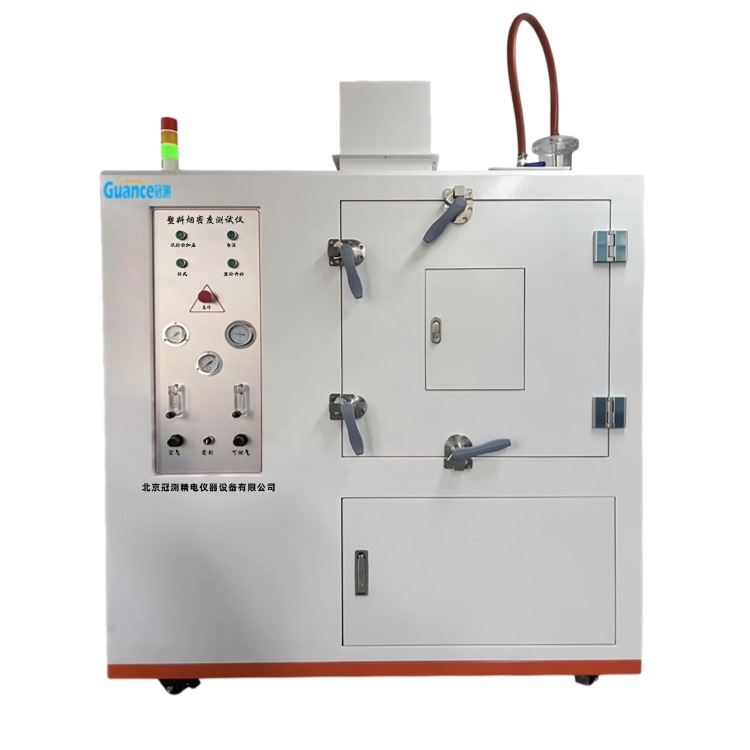
The testing cigarette box is the core part of the entire equipment. This is a box with good sealing and corrosion resistance, and the inner wall is usually designed with dark colors to reduce the interference of light reflection. The box is reasonably equipped with functional components such as observation windows, sample installation ports, combustion system interfaces, and cleaning vents.
The combustion system is crucial for simulating different fire scenarios. According to testing requirements, the system is usually equipped with two different working modes. One is the flame combustion mode, which applies an open flame to the sample through a specific flow of gas burner, simulating the real situation of the material being directly ignited. Another type is flameless combustion mode, which uses an electrically heated radiation device to irradiate the sample with standard thermal radiation power, simulating the process of smoldering or pyrolysis of the material due to thermal radiation from a nearby fire source.
The precise photoelectric measurement system ensures the accuracy of the test. The light source must remain highly stable to ensure consistent illumination throughout the entire testing process. The photosensitive element needs to have a wide measurement range and fast response capability in order to accurately capture every detail of the instantaneous changes in smoke concentration.
The gas control system is responsible for providing precise and stable gas and air flow to the burner, which is an important step in ensuring the repeatability of testing conditions. Modern testers are also equipped with professional data processing software that can display real-time transmittance change curves, automatically calculate key indicators, and generate complete test reports.
3、 The Importance of Testing Standards
The testing of plastic smoke density is based on strict testing standards. These standards provide detailed regulations for each stage of testing, including preparation requirements for test samples, specific test condition settings, standardized steps in the operation process, and criteria for determining the final results.
China has established a comprehensive standard system in this regard, which is basically consistent with the relevant regulations of other countries. Especially in special fields such as aviation, shipping, and rail transit, relevant regulations mandate the use of such equipment for smoke density testing of interior materials to ensure public safety in these areas.
4、 Application value and development prospects
The application of plastic smoke density tester has been integrated into various aspects of material research and development, quality control, and regulatory certification.
In the field of material research and development, it helps researchers develop new plastic materials with low smoke and high flame retardancy, promoting technological progress in the industry. For manufacturing enterprises, testing equipment is an important tool for product quality control, ensuring that factory products comply with industry safety standards and enhancing their market competitiveness. At the same time, the test data also provides necessary admission certificates for products such as construction, transportation, and electronics to enter specific markets.
With the continuous advancement of technology, future smoke density testers will develop towards higher levels of integration and intelligence. For example, new devices are capable of simultaneously measuring smoke density and analyzing toxic gases, providing more comprehensive data support for material safety assessments. By combining advanced data analysis techniques, researchers can more accurately predict the behavior of materials in real fires, which will open up new avenues for fire safety scientific research.
Conclusion
As an important technical equipment for safeguarding modern life safety, the plastic smoke density tester transforms the intangible threat of 'thick smoke' in fires into quantifiable and comparable scientific data through precise physical measurements. Through rigorous analysis and application of these data, we can not only screen for safer materials, but also promote the entire industry towards higher safety standards, buy valuable time for protecting life and property safety, and create a safer living environment.