-
E-mail
sales@chotest.com
-
Phone
18928463988
-
Address
No. 1001, Xili Xueyuan Avenue, Nanshan District, Shenzhen, China
Shenzhen Zhongtu Instrument Co., Ltd
Microscopic assassin! Scanning electron microscopy mosquito observation image, revealing the true face of Aedes mosquitoes spreading chikungunya fever
Date: 2025-11-26Read: 100
A pair of compound eyes shimmered with eerie light, and each mouthpiece was like a sharp sword blade - this is the ferocious appearance of the Aedes mosquitoes that spread chikungunya fever under scanning electron microscopy. The CEM3000 series desktop scanning electron microscope independently developed by Zhongtu Instrument, combined with electron acceleration and deceleration inside the tube and composite lens design, can directly observe electron beam sensitive samples as low as 1KV, exposing the true face of this "microscopic assassin" that spreads diseases.

PS: The mosquitoes in the article were not sprayed with gold and were directly scanned and imaged
Recently, there have been outbreaks of chikungunya fever in some cities in southern China, which have caused local transmission. During the week of October 19-25, 2025 alone, Guangdong Province reported 868 new cases. This viral disease, transmitted by Aedes mosquitoes (commonly known as "flower mosquitoes"), is named after the local language in southern Tanzania, Africa, which means "causing people to bend over and back", describing the posture of patients bending over due to severe joint pain. Below is CEM3000beltWe will delve into the tiny "culprits" of this epidemic and unlock the micro transmission code.
1、 Fever Attack: Get to Know Chikungunya Fever
Chikungunya fever is an acute mosquito borne infectious disease caused by the Chikungunya virus, with a typical incubation period of 3 to 7 days. The typical clinical manifestations are triad: fever, joint pain/arthritis, and rash. The most typical symptom is "severe pain in the wrist joint under pressure", which often makes patients unable to dress independently due to the pain.
Compared to dengue fever, chikungunya fever "hurts longer" and dengue fever "is more dangerous". The danger of dengue fever lies in its severe condition, which may lead to severe bleeding, shock, or even death; Although chikungunya fever is less life-threatening, its characteristic joint pain is often more persistent.
2、 Microscopic Assassin: The Unknown Precise Structure of Mosquitoes
In the eyes of ordinary people, Aedes mosquitoes are just annoying little flying insects; But under the magnification of scanning electron microscopy, they reveal their true colors - precise and efficient "flying syringes" that are breathtaking - far from simple "straws". It is a precision feeding tool composed of six thin needles, including two esophageal tubes, two saliva tubes, and two puncture needles with serrated structures. These needles are much thinner than a strand of hair, yet they can easily penetrate human skin.

The wings of mosquitoes are a natural engineering miracle. Under the electron microscope, mosquito wings exhibit a series of complex feather like structures arranged in an orderly manner, resembling exquisite works of art. It is this structure that gives mosquitoes the ability to fly, allowing them to approach their prey silently.

(Image: The bristles on mosquito wings are arranged in an orderly manner)
Mosquito antennae are covered with fine hairs, divided into mechanical sensory hairs and chemical sensory hairs. Mechanical hair senses airflow and vibration to assist in obstacle avoidance; Chemical wool can detect host sweat odor, body temperature, and carbon dioxide, accurately locating targets. Male mosquitoes have thicker antennae and can recognize the frequency of wing vibration in females, assisting in courtship and serving as a key sensory structure for survival and reproduction.
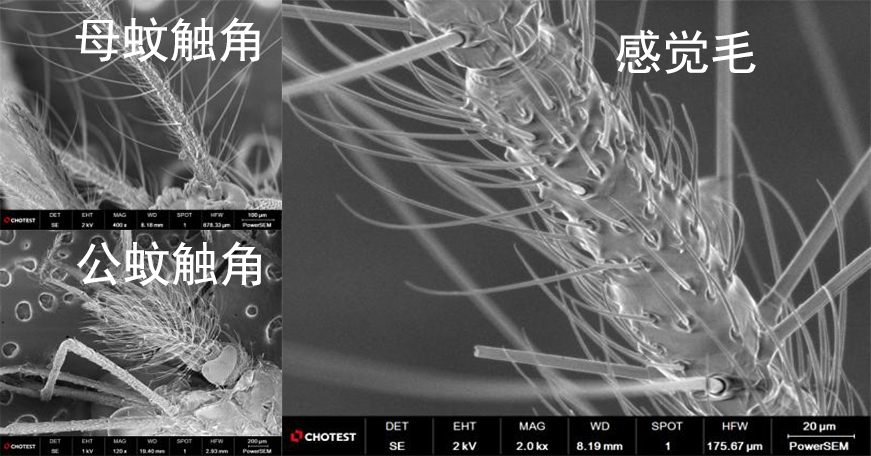
(Image: Antennas of female and male mosquitoes)
The compound eyes of Aedes mosquitoes are composed of a large number of small eyes, which are densely arranged under scanning electron microscopy; Having a wide range of vision and fast response, it can accurately capture the host's movements and adapt to the habit of avoiding light and attacking, which is the key sensory for its efficient hunting.
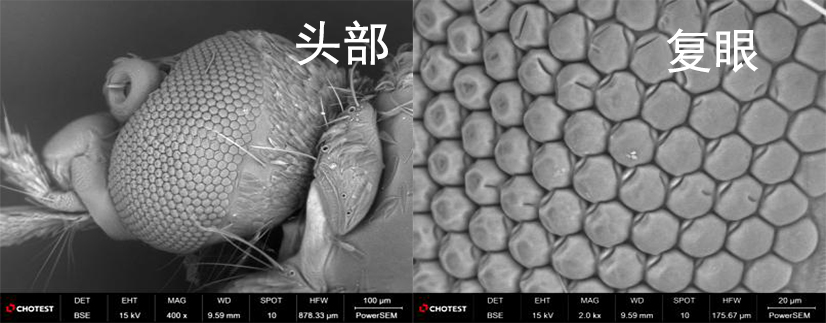
(Image: Mosquito Head and Compound Eyes)
The nano scales on the legs of Aedes mosquitoes are waterproof, and the micro hairs on the feet are strongly attached, making them suitable for multiple scenarios and demonstrating the precision of natural evolution.
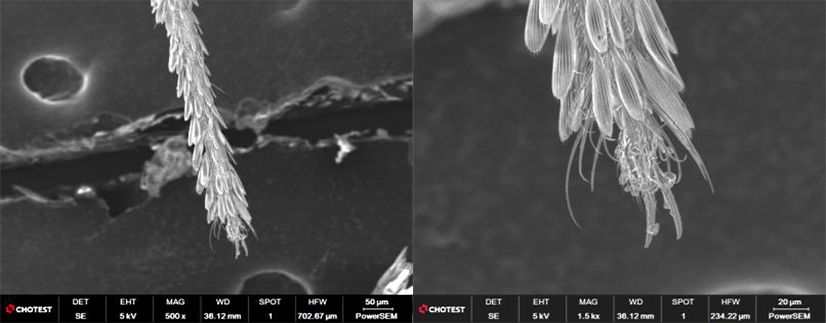
(Image: Mosquito legs and foot pads)
A researcher described operating under a scanning electron microscope as "like swimming in a microcosm, where every detail is infinitely magnified, revealing the mysteries of nature
3、 Virus transmission: the "transmission storm" of the microscopic world
Chikungunya fever will not be transmitted from person to person through daily contact. How did it spread?
The viral load in the blood of patients is high within one week after the onset of the disease. If they are bitten by mosquitoes at this time, the virus will multiply in the mosquito's body for 2-10 days, and then bite healthy people to spread, "explained an expert from the Prevention and Control Institute of the Shenzhen Center for Disease Control and Prevention.
Aedes mosquitoes can complete their development from eggs to adults in almost 7 days under suitable conditions above 30 ℃. A mosquito carrying a virus can bite multiple people, which is also an important reason for its rapid spread in the short term.
4、 Preventive measures: eliminate mosquito breeding grounds
1. Indoor
The core of mosquito prevention and control is to cut off the breeding source. The Guangdong Provincial Center for Disease Control and Prevention advocates "clearing accumulated water for three minutes every day", focusing on areas prone to water accumulation in homes and outdoors. Specific operations can be carried out according to the four principles of "clearing, sealing, filling, and draining":
2. Outdoor
Change the water bottles for aquatic plants every week, empty the flowerpot trays, air conditioning and water dispenser trays of accumulated water, and eliminate hidden water accumulation points;
Cover water tanks, water tanks and other water storage containers, fill in depressions, wastewater ponds, bamboo holes and tree holes, dredge ditches, clean up mud and weeds on the shore, and reduce the living space for mosquito larvae from the source.
5、 Bite prevention: Multi tube approach
1. Install
To prevent chikungunya fever, the core measures include "eliminating mosquitoes, clearing stagnant water, and preventing bites". Personal protection can implement four measures:
2. Drive/extinguish
Install screen doors and windows at home, use mosquito nets at night to prevent mosquitoes and insects from entering;
3. Separation
Exposed skin and clothing shall be smeared with mosquito repellent products containing DEET, DEET, Pekaritin and other ingredients, and mosquito killing tools shall be used to kill adult mosquitoes when necessary;
4. Avoid
Wear light colored long sleeved pants when going out to reduce the exposed area of the skin;
Avoid the active period of Aedes mosquitoes (7-10am, 4-7 pm), and do not linger in dark and humid outdoor areas such as tree shade, grass, pavilions, etc.
6、 Scanning Electron Microscopy: A Bridge between Macroscopic and Microscopic Perspectives

The CEM3000 series desktop scanning electron microscope exposes the true face of this "microscopic assassin" who spreads diseases. The value of scanning electron microscopy goes far beyond mosquito observation: in materials science, it can analyze the surface morphology and internal structure of materials, assisting in the development of new materials; In the field of industrial manufacturing, providing support for precision machining quality control; In multiple fields such as life sciences, nanotechnology, and earth sciences, its imaging advantages of high resolution, large depth of field, and high contrast have become core tools for scientific research and technological innovation, building a cognitive bridge between macroscopic phenomena and microscopic essence.
