-
E-mail
376786168@qq.com
-
Phone
18971653633
-
Address
13th Floor, Zhongjian Guanggu Star Mansion, No. 799 Gaoxin Avenue, Donghu High tech Zone, Wuhan City, Hubei Province
Wuhan Shuntong Intelligent Technology Co., Ltd
Application of Shuntong Cloud Digital Twin in the Integration of Light Storage and Charging in a Certain Expressway Network Project
Date: 2025-08-22Read: 7
1Project Introduction
The popularization of new energy vehicles promotes the large-scale layout of charging piles, photovoltaics, and energy storage in high-speed service areas, promoting the transformation of the high-speed energy system from "single electricity load" to "integrated source grid load storage". This transformation reconstructs the logic of road derived economic energy, and the integration and management model of new energy technologies adapted to different scenarios has become the key to ensuring system security and improving efficiency.
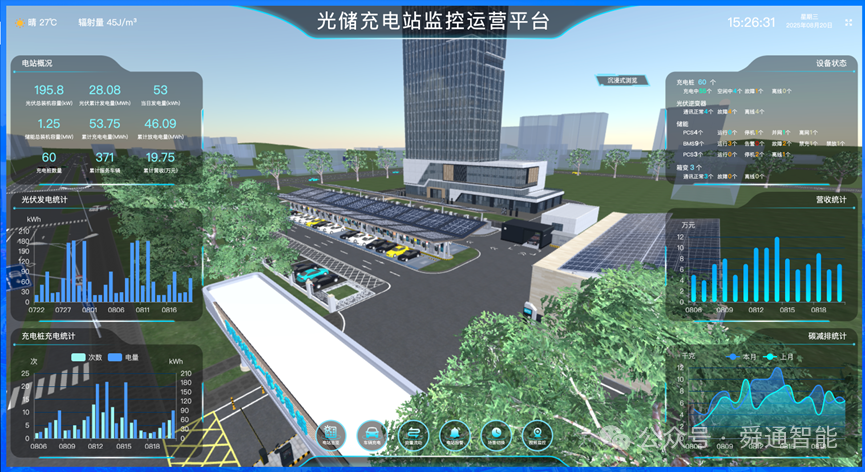
Shuntong Optical Storage and Charging Digital Twin Management Platform, with the core of "digital mapping of physical scenes+intelligent control of the entire process". We conducted on-site investigation, drone aerial photography, data collection and other preliminary preparations. Through modeling, 3D visualization development, and data processing, we used digital twin 3D visualization technology to 1:1 restore the on-site layout and equipment status, and built a "real-time collection dynamic feedback intelligent decision-making" closed loop. The platform integrates key data from photovoltaics, energy storage, and charging, and optimizes conversion efficiency, storage strategies, and load distribution through algorithms to achieve precise regulation throughout the entire chain, balancing efficiency, stability, and safety.
Multi layer collaboration of system functions: displaying equipment and parameters through 3D visualization; Simulate energy circulation to assist in operation and maintenance; Monitor anomalies and issue warnings; Generate scheduling plans to achieve peak shaving and valley filling, balance supply and demand, utilize clean energy, and reduce costs.
IItechnical implementation
1. 3D model production and editing
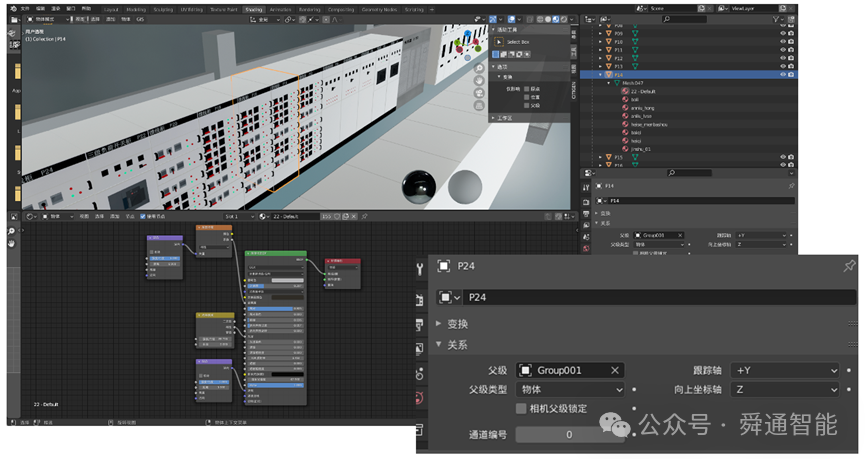
throughpassblenderModeling software models aerial images, and after the model is created, the spatial structure of the model is subjected to secondary analysisNaming confirmation facilitates web parsing and processing.
2. Model structure interaction configuration
According to the model scenario and project requirements, perform structured digital processing on the model structure and interactive functions.
Model organization processing: usuallyIt is to process models of the same type that are repeatedly rendered in the scene, extract numbers from the models, and configure model structural information such as model relative coordinates, model features, model materials, model textures, model specific attributes, etc; Greatly improve the rendering speed and loading speed of the model in the scene; Also provide necessary parameters for model interaction.
Interactive configuration: According to project requirements, the interactive functions mainly include model clicking, model color changing, model alarm, model movement, scene switching, etc.

3. Web platformThreejs rendering engine
Threejs rendering engine for web platformWebGLBased on the Threejs architecture, first perform configuration file parsing and model loading, and then assemble models such as scenes, cameras, renderers, and lighting; The front-end of the platform is rendered using Canvas and supports user drag, zoom, and other interactions. It can achieve functions such as clicking on model pop ups, real-time data refreshing, etc. It can also expand interactions such as small model pop ups and alarm color changes through secondary business development (providing interactive APIs), building a rendering system with rich interaction and visualization capabilities.

IIIFeature Demo
1. Photovoltaic power generation
The platform supports multiple types of data interfaces (such as inverter RS485, IoT gateway), real-time collection and analysis of the operating parameters of each inverter in the photovoltaic array, including but not limited to cumulative power generation, real-time power generation, daily power generation, power curve, equipment temperature, etc., and accurately maps these data to the corresponding 3D modelPhotovoltaic panel moduleUp - Users can click on any photovoltaic panel model to display detailed data of its associated inverter in a pop-up window.
At the same time, the module has data trend analysis function, which can automatically generate daily/monthly/annual power generation curves, compare historical data of the same period, and assist operation and maintenance personnel in determining whether the efficiency of the photovoltaic system meets the standard. When there is a sudden drop in power generation or an offline inverter, the system will link with the equipment alarm module, trigger the photovoltaic panel model to change color (such as turning red), and synchronously push the preliminary diagnosis of the cause of the abnormality (such as "possible low power of inverter 12 due to obstruction"), improving the operational response efficiency of the photovoltaic system.

2. Vehicle charging
In the digital twin scenario, the status of charging vehicles and stations is mapped in real-time: the vehicle model dynamically displays the state of charge (SOC), and the charging stations are marked with colors to indicate their working status (green constant, yellow warning, red fault), synchronously presenting real-time power. The system is linked with photovoltaic storage data to automatically allocate energy - increasing charging power when photovoltaic surplus occurs, prioritizing the use of energy storage for power supply during peak hours, supplementing energy storage during valley hours, and supporting remote start stop and fault warning. It efficiently matches the "photovoltaic storage charging" synergy to enhance the reliability of green power consumption and charging.

3. Scene switching
The scene switching function is based on the dynamic modeling capability of digital twins, achieving real-time linkage between physical and virtual scenes, and providing multi-dimensional environmental adaptation support for energy scheduling.
The system automatically triggers scene mode switching by integrating real-time data from local meteorological stations (temperature, light intensity, precipitation probability, etc.), covering typical scenarios such as day/night, sunny/cloudy/rainy/snowy days, etc; Simultaneously supporting manual switching mode for operation and maintenance personnel to simulateSuch as rainstorm and sandstormThe operational status of the energy system under weather conditions.
This function visualizes the correlation between the environment and the energy system, allowing dispatchers to more intuitively predict the energy supply and demand balance in different scenarios and formulate response plans in advance.

4. Video surveillance
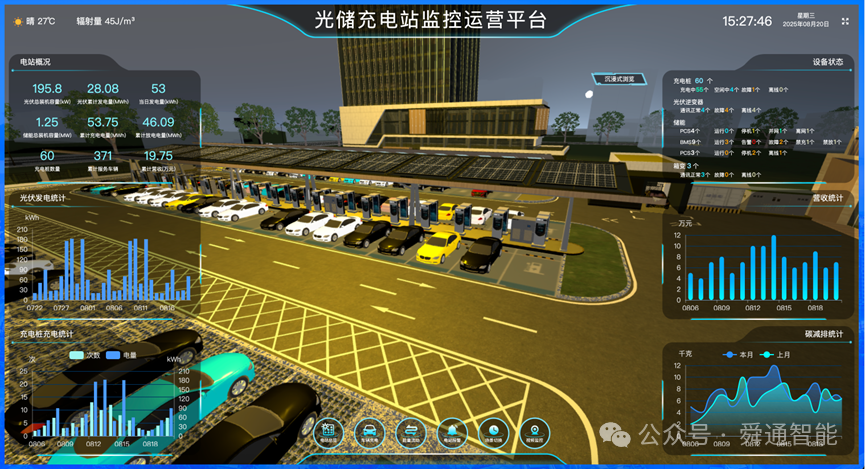
The video surveillance function realizes the spatial integration of physical scene cameras and digital twin 3D models, and constructs a linkage monitoring system of "virtual scene real scene".
The platform connects high-definition cameras within the service area (covering key areas such as photovoltaic areas, energy storage stations, charging pile groups, and distribution rooms) through SDK, and embeds real-time video streams into the corresponding 3D model positions. For example, if the user clicks on "Charging Pile 3" in the model, the system will automatically retrieve the real-time image of the camera in front of the charging pile, and clearly view details such as the vehicle charging status and gun head connection; Click on the "Energy Storage Station" model to switch to the panoramic camera screen inside the station, monitoring the operating environment of the energy storage battery pack.


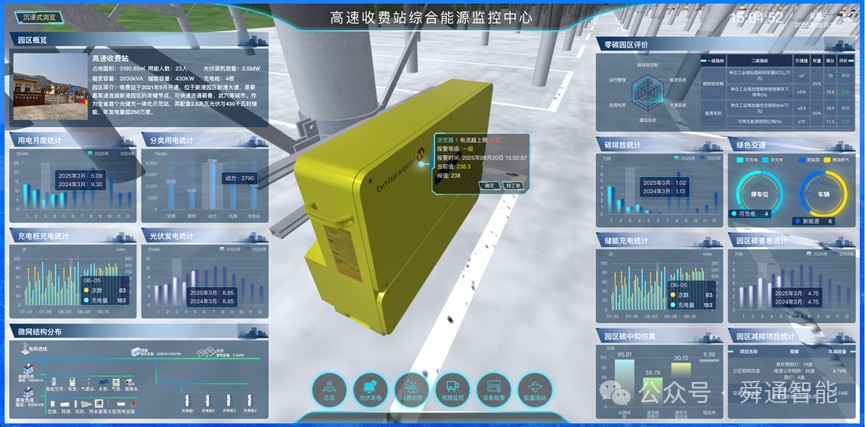
5. Equipment alarm
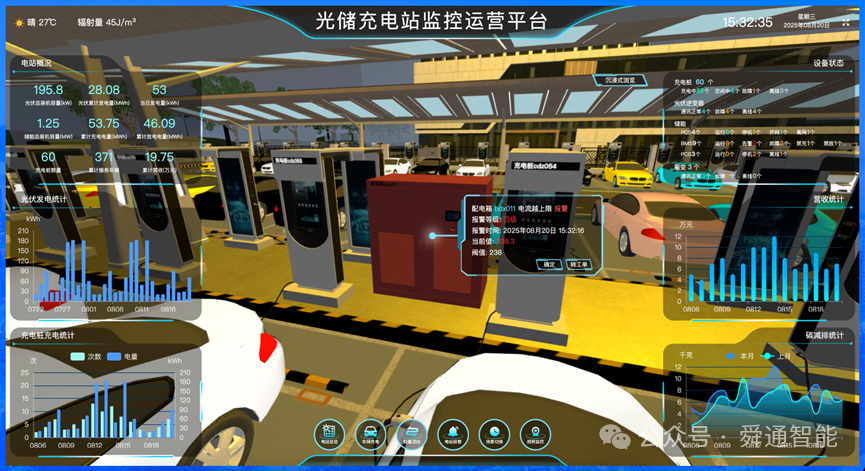
The equipment alarm function establishes a closed-loop management mechanism of "anomaly recognition grading warning linkage disposal" by monitoring the operating parameters of key equipment in real time, ensuring the safe and stable operation of the energy system.
The system pre-set alarm thresholds for multiple types of devices (such as inverter current upper limit, energy storage battery temperature upper limit, charging pile voltage fluctuation range, etc.), and collects real-time data through sensors and compares it with the thresholds. When an exception occurs, the system will immediately trigger an alarm.
Through this function, the detection and handling time of equipment abnormalities is reduced by more than 60% compared to traditional manual inspections, significantly reducing the risk of energy interruption caused by equipment failures.
4Project application value
This project achieves collaborative control through digital twin and optical storage chargingEnergy utilization efficiency and operational benefitsThe Double Breakthrough:
economic value:Integrate photovoltaic, energy storage, and charging needs, dynamically allocate energy flow - increase charging power when photovoltaic surplus, prioritize energy storage for power supply during peak hours, and supplement energy storage during valley hours, significantly reducing the cost of purchasing electricity from the power grid. For example, similar projects can increase the photovoltaic consumption rate to 99.7% through photovoltaic storage collaboration, increase energy storage arbitrage profits by more than 25%, and reduce comprehensive operating costs by 18% -25%.
social benefits:Visualize charging progress, disclose energy sources, and guide peak shaving through a digital twin interface to optimize user experience; At the same time, the load balancing algorithm is used to smooth out power grid fluctuations and reduce the pressure of regional power grid expansion.
environmental benefits:Strengthening the capacity of green power consumption, for example, a certain project reduces carbon dioxide emissions by about 176 tons per year, and users can clearly perceive that "photovoltaic power accounts for 78%+energy storage power accounts for 22%" when charging, promoting efficient coordination between transportation energy and renewable energy, and supporting the "dual carbon" goal.
5Highlights of Technological Innovation
The project is constructed through cross domain technology integration:
Deep application of digital twin
Realize three-dimensional dynamic mapping between charging vehicles and charging stations, synchronize SOC progress, power fluctuations and other parameters in real time, and identify status with colors (green constant, yellow warning, red fault), combined with multi-dimensional data dashboards (whole station/single station data), to form a transparent management of the entire process.
Integrated video surveillance and maintenance work order system, automatically retrieves on-site images and generates traceable operation and maintenance files in case of faults, improving response efficiency.
Collaborative control technology for photovoltaic storage and charging
Microgrid control technology based on large models, integrating meteorological and load forecasting data, dynamically optimizing energy storage charging and discharging strategies.
Multi source data fusion algorithm realizes dynamic allocation of "light storage charging", supports minute level strategy adjustment and second level control response, and accurately matches energy supply and demand.
Intelligent prediction and flexible regulation
Using multi time scale perception technology, the energy situation is predicted 72 hours in advance, and the best strategy is generated based on the electricity market's time of use price. The system uses AI load forecasting to increase the photovoltaic consumption rate to over 85%.
Support full DC energy architecture and V2G technology, achieve bidirectional interaction between electric vehicles and the power grid through V2G charging piles, increase green electricity utilization rate by 10% annually, and promote the implementation of the "mobile energy storage" mode.
Full chain security guarantee
Integrating 12 types of fault monitoring and a three-level safety protection system, the system uses multi parameter fusion diagnosis to warn of battery abnormalities 14 days in advance, reducing the charging failure rate from 1.2% to 0.15%.
Combining blockchain technology to achieve compliant energy trading certification, the platform automatically generates revenue reports and carbon emission data to support green certificate application and carbon quota trading.
VIsummary
This project has been approved Digital Twin - Intelligent Algorithm - Energy Collaboration - Security ProtectionFour dimensional innovation not only provides a refined management paradigm for photovoltaic charging stations, but alsoHigh green electricity consumption rate, low operating costs, and excellent user experienceThe core advantage has become a practice of integrating new power systems with smart transportation.