-
E-mail
sungoll@126.com
-
Phone
13160107223
-
Address
120, Building 2, No. 83, Beixiang North Road, East the Taihu Lake Lake Eco tourism Resort (the Taihu Lake New Town), Wujiang District, Suzhou
Product Categories
Suzhou Shanggao Testing Equipment Co., Ltd
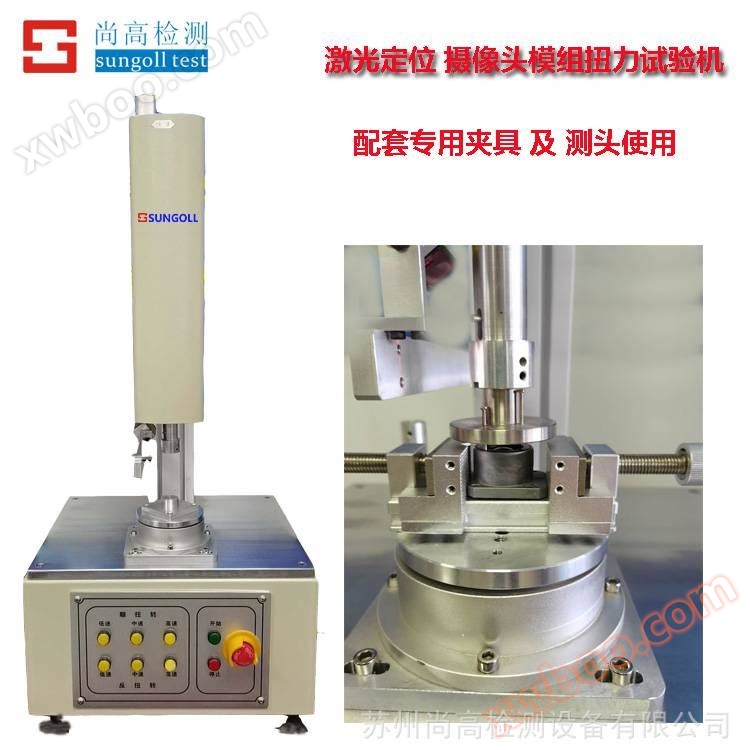


5000AS torsion testing machine camera torsion testing machine
NegotiableUpdate on 03/13
- Model
- Nature of the Manufacturer
- Producers
- Product Category
- Place of Origin
Overview
Fully automatic camera module torque testing machine 5000AS torque testing machine camera torque testing machine I. Product application: The camera module torque testing machine is designed specifically for testing small cameras
Product Details
Fully automatic camera module torsion testing machine 5000AS torsion testing machine camera torsion testing machine


1、 Product application:
The camera module torque testing machine is designed specifically for testing small cameras. Due to the small displacement and torque of the micro camera during focusing, as well as the need to consider the alignment of the upper and lower fixtures, certain improvements need to be made to the mechanism of the testing machine. During the torsion test, the camera should try its best toreduceMove up and down with minimal external force. The upper and lower fixtures ensure easy alignment. This servo torque testing machineforcameraModule industry developmentProduct related torque testing and torque life testing. Adopting a DSP acquisition and control system, all experimental conditions can be freely set through an industrial computer paired with a Windows Chinese window. The operation is simple and convenient, and all data can be stored.
2、 Specification parameters:
Load element: Choose one of 1N. m, 5N. m, 10N. m, or 20N. m.
Small resolution: 0.01°
Measurement angle:
Fine tuning distance 0.01°
Rotating up and down automatic travel: 150mm
Automatic height measuring device: 0-50mm
Height measuring device display: 0.01mm
Measurement speed range: 0-30 revolutions per minute
Automatic heart seeking device: 1mm each for XY
Transmission mechanism: Taiwan planetary gearbox
Motor: Mitsubishi servo motor from Japan
IIIEquipment composition:
Test one local machine
1 industrial computer host
1 19 inch LCD monitor
1 set of control software
1 set of torque self centering device
fixture1 set
Fixed seat (compatible with 7-12mm products)1 set
1 set of automatic height measuring device
4Machine features
*The machine is driven by a servo motor and tested for torque provided by a planetary gearbox.
*The testing conditions are set by the computer screen and can be stored.
*It can directly test the changes in torque values at each angle (torque angle curve change chart).
*Simultaneously display the torque angle curve and torque decay life curve.
*Can store and print graphics (torque angle curve, torque decay life curve, inspection report).
*The inspection report is automatically printed and can be converted for output or directly output through the network.
*The upper and lower limits of the test can be entered, and the machine will automatically stop if it exceeds the specifications.
*Adjustable torque values: positive torque, negative torque, positive torque+negative torque.
*Test the direction of travel: forward to outbound, forward to outbound+return. Reverse outbound, reverse outbound+return. Forward travel+Reverse travel+Forward travel.
5Torque angle curve chart:
*It can directly record the changes in torque values at each angle. (X-axis represents angle, Y-axis represents torque)
*Each measurement graph can be traced by a crosshair cursor to determine the corresponding torque and angle values, with a small accuracy of 0.1 degrees.
*The curve is automatically stored by the computer, can be enlarged or reduced at any time, and N curve graphs can be placed on a piece of paper at will.
*Scroll style curve chart display, allowing for arbitrary browsing of the curve chart.
VILife curve chart:
*The content of the report header can be freely set.
*The report can display the value, minimum value, and average value of each curve.
*The report can display the specification lines for the upper and lower limits of the test.
*Multiple sets of life curve graphs can be set to be displayed simultaneously.
*Automatically calculate the torque attenuation rate.
7The experimental condition setting operation is simple:
*The Chinese window screen setting operation is simple.
*The testing conditions are set by the computer screen and can be stored.
*Select settings from the drop-down menu or enter data directly. (including determination of force type, direction of travel, load measurement range, angle measurement range, travel origin position, travel origin detection, measurement speed, measurement frequency, pause time, and waiting position for each time)
*Measurement items and specification settings: The upper and lower limit specification values and test results can automatically determine whether they are OK or NG.


Similar Product Recommend