-
E-mail
2442648961@qq.com
-
Phone
13023169219
-
Address
No. 3666 Changcheng Road, Mudan District, Heze City, Shandong Province
Product Categories
Shandong Sairuite Testing Instrument Co., Ltd
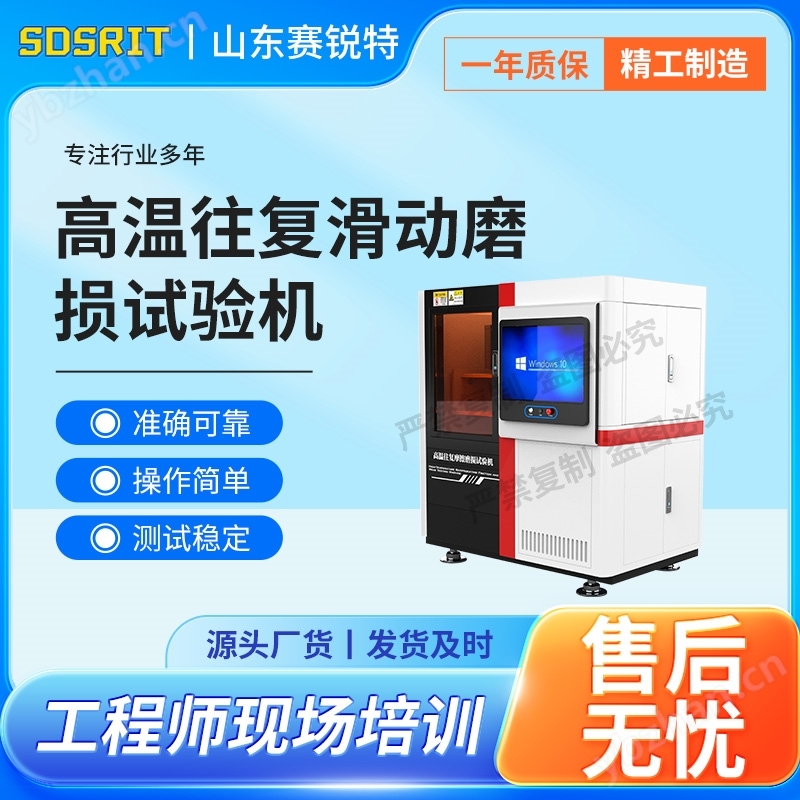


High temperature reciprocating sliding wear testing machine with improved after-sales service
NegotiableUpdate on 11/20
- Model
- Nature of the Manufacturer
- Producers
- Product Category
- Place of Origin
Overview
High temperature reciprocating sliding wear testing machine with improved after-sales service. The high-temperature reciprocating friction and wear testing machine can simulate high and low temperature, electrochemical corrosion environments within an adjustable reciprocating frequency range under small contact pressure, and is used for testing the friction and wear performance of materials or coatings under reciprocating motion conditions.
Product Details
High temperature reciprocating sliding wear testing machine with improved after-sales serviceHigh temperature reciprocating sliding wear testing machine with improved after-sales service
High temperature reciprocating sliding wear testing machine, high temperature reciprocating friction wear testing machine
Instrument Introduction:
The high-temperature reciprocating friction and wear testing machine can simulate high and low temperature, electrochemical corrosion environments within an adjustable reciprocating frequency range under small contact pressure. The reciprocating motion condition is used for testing the friction and wear performance of materials or coatings. This device can dynamically monitor parameters such as friction force, test force, and test temperature in real time. This device integrates functions such as detection, collection, drawing, storage, and report generation. The main parameters all have over preset alarm protection or shutdown functions
The equipment moves in a reciprocating mode and is mainly used for testing the friction and wear performance of materials and surface coatings. Adopting industrial control computer control, the entire testing process is monitored and controlled in real time, with automatic constant loading of testing force and dynamic alternating loading (sine wave, triangular wave, square wave, trapezoidal wave), ensuring stable and reliable loading. It can simulate three forms of contact friction: point, line, and surface, and perform reciprocating motion to measure various parameters such as friction and wear under different loads, reciprocating frequencies, lubrication conditions, and temperatures.
Expandable corrosion resistance function, simulating experimental measurements in deep-sea environments.
Compliant with standards:
ASTMG133 "Standard Test Method for Sliding Wear of Linear Reciprocating Balls on Flat Plates"
Main parameters:
Control system: PLC or Windows
Operating interface: 15 inch industrial control all-in-one computer
Test load: 0-500N Accuracy: ± 1%
Range of reciprocating friction force: 0-100N Accuracy: ± 1%
Reciprocating frequency: 0.05-20Hz
Reciprocating friction forms: ball disc, pin disc, column tile
Lifting height: 60mm
Journey: 2.5-40mm
Conventional testing temperature: 0~800 ℃
Electrochemical testing temperature: room temperature to 40 ℃
1 set of electrochemical workstation (optional)
储液池尺寸: 120mmx90mmx50mm、 容量300 m(选配)
Power supply: AC220V2.5KW
Brief description of the structure of the testing machine
The testing machine mainly consists of a driving mechanism, a load loading mechanism, a reciprocating module, a friction pair clamping mechanism, a high-temperature heating device, an electrochemical testing module (optional), and a high-temperature heating device
Including customized high-temperature furnaces, thermocouples, and temperature control meters. The temperature control meter controls the internal temperature of the high-temperature furnace through thermocouple signal feedback, and another thermocouple is used to measure the temperature of the test sample and provide real-time feedback to the software to draw the corresponding temperature curve. The high-temperature furnace shell is made of non decorative stainless steel, with high temperature resistance and good appearance resistance; The furnace structure adopts a symmetrical and circular insulation groove. Temperature control range: room temperature~800 ℃; Temperature control accuracy: ≤ ± 2 ℃, composed of signal acquisition and processing, electrical control, and other components.
1) Drive mechanism: The spindle is driven by a servo motor and a servo speed regulation system. The system has a stepless speed regulation of the motor, with an accuracy of 1% at high speeds. The motor is directly connected to the spindle seat, and the torque will not decay. The upper end of the spindle seat is eccentric to achieve reciprocating motion.
2) Load loading mechanism: The loading mechanism is driven by a stepper motor and transmitted through a circular arc toothed belt, a synchronous belt pulley, and a precision ball screw pair. It is guided by a precision linear motion guide rail, which drives the force application seat to move up and down. The force application seat is fixed with a linear guide rail, a test force sensor, and a compression spring on its upper surface. The force application seat moves upward and comes into contact with the upper sample friction pair seat, compressing the spring, thus forming a load between the friction surfaces of the upper and lower samples.
3) Reciprocating module: This module consists of an eccentric adjustment wheel, connecting rod, spindle rod, linear fixing device, and reciprocating friction pair.
4) Reciprocating friction pair mechanism: commonly equipped with ball to disc (point contact), pin to disc (line contact), and surface contact; It also has expansion functions. If customers need it, optional components can be selected: curved friction components, cylinder liner piston ring components, and high-temperature sample components.
5) High temperature heating device: including customized high temperature furnace, thermocouple, and temperature control meter. The temperature control meter controls the internal temperature of the high-temperature furnace through thermocouple signal feedback, and another thermocouple is used to measure the temperature of the test sample and provide real-time feedback to the software to draw the corresponding temperature curve. The high-temperature furnace shell is made of non decorative stainless steel, with high temperature resistance and good appearance resistance; The furnace structure adopts a symmetrical and circular insulation groove. Temperature control range: room temperature~800 ℃; Temperature control accuracy: ≤ ± 2 ℃
6) Electrochemical testing module (optional)
7) Computer control unit: mainly includes electrical control system, computer control system, and safety protection system.
(1) The electrical control system includes strong current system and weak current control system. The high-voltage system provides 220V power to the equipment and effectively controls power on and off through a weak point control system. The weak current control system includes control components such as boards and modules, which realize the collection, transmission, and feedback functions of test data. It has strong anti-interference ability and high signal stability.
(2) The computer control system mainly consists of an industrial control computer dual core, a 4G processor, 256GB memory, a 15 inch LCD display, and software components. The host uses an Advantech industrial control computer.
Electrochemical working station parameters (optional)
Constant potential control range: ± 10V |
Constant current control range: ± 2.0A |
Potential control accuracy: 0.1% * full-scale reading ± 1mV |
Current control accuracy: 0.1% * full-scale reading |
Potential sensitivity: 10uV (>100Hz), 3 μ V (<10Hz) |
Current sensitivity:<10pA |
Potential rise time:<1 μ S (<10uS) (<10mA), (<2A) |
Current range: 2A~200nA, 8 levels in total |
Reference electrical input impedance: 1012 Ω | | 20pF |
Z large output current: 2.0A |
Slot pressure output: ± 21V |
Current scan increment: 1mA@1A /mS |
CV and LSV scanning speed: 0.01mV~10000V/s |
DPV and NPV pulse width: 0.0001-1000s |
CA and CC pulse width: 0.0001~65000s |
Z small potential increment of CV: 0.075mV |
SWV frequency: 0.001~100KHZ |
Current and potential range: automatic setting |
|
AD data collection: 16bit@1MHz , 20bit @1kHz |
Low pass filter: 8-segment programmable |
DA resolution: 16 bits, setup time: 1 μ S |
|
Communication interface: USB 2.0 |
Basic configuration:
Test host: 1 unit
Instruction manual: 1 copy
Certificate of conformity: 1 copy
Receipt: 1 copy
Wrench: 1 piece
Computer host: 1 set
Monitor: 1 set:
Communication cable: 1 set
Similar Product Recommend