-
E-mail
china_zhikuan@163.com
- Phone
-
Address
213, 2nd Floor, Building 5, No.16 Junying Street, Shunyi District, Beijing
Product Categories
Beijing Zhikuan Information Technology Co., Ltd
Intelligent Case Handling Center Positioning System Solution
NegotiableUpdate on 09/17
- Model
- Nature of the Manufacturer
- Producers
- Product Category
- Place of Origin
Overview
The positioning system scheme of intelligent case handling center Chapter 1 Preface The Internet of Things is the Internet connected by things, which means that the core and foundation of the Internet of Things is still the Internet, which is an extension and expansion of the network on the basis of the Internet. In addition, its user end extends and expands to any item and item for information exchange and communication
Product Details
Intelligent Case Handling Center Positioning System Solution
Chapter 1 front words
The Internet of Things is the Internet connected by things, which means that the core and foundation of the Internet of Things is still the Internet, which is an extension and expansion of the network on the basis of the Internet. In addition, its user end extends and expands to any item and item for information exchange and communication. The Internet of Things20At the end of the century, the definition of the Internet of Things emerged through radio frequency identification(RFID), sensors, positioning systems, scanners, sensors and other information sensing equipment, according to the agreed protocol, connect items with the Internet for information exchange and communication, to achieve intelligent identification, positioning, tracking, monitoring and management. The Internet of Things can only be said to be in its early stages of development. The Internet is the need for communication between people, and the Internet of Things reflects the need for communication between things. That is to say, we can communicate with each other well now through the technology of the Internet, and we will rely on the Internet of Things to promote in the future. The information transmission mode, protocol, information volume, access volume, and communication mode of the Internet of Things are somewhat different from the way people use the Internet to communicate. More importantly, it connects these devices together through sensors to collect data from these devices, including real-time responses, that is, how do we reverse control these devices. estimated2025The annual meeting is approaching5000Billion devices are connected to the Internet, that is, at the level of the Internet of Things, nearly5000The trillion dollar amount of data is the arrival of the true era of big data.
Our country is2010The definition of China's Internet of Things was made in the annual Central Government Work Report:“A network that connects various networks through sensor devices according to agreed protocols for information exchange and communication, in order to achieve intelligent identification, positioning, tracking, monitoring, and management.”
With the development of IoT technology in China, it has gradually been applied in various fields such as public safety, urban management, energy and environmental protection, transportation, public utilities, agricultural services, medical and health care, education and culture, tourism, etc. It will continue to develop rapidly in the coming years. withRFIDIn recent years, the development of sensor technology, short-range communication, and computing technology has expanded its research and application to fields such as environmental monitoring, biomedicine, and intelligent infrastructure. At the same time, it has a leading advantage in key technologies of the Internet of Things.
In recent years, the continuous deepening of standardized law enforcement construction has put forward higher and more detailed requirements for the hardware facilities of law enforcement in areas such as case handling functional zones of public security industry organs. To curb and prevent the occurrence of incidents such as forced confessions by torture from the source, eliminate illegal evidence, and further regulate the law enforcement behavior of public security industry organs. This also echoes the requirements of the Fourth Plenary Session of the 18th Central Committee, which aims to improve the legal norms, implementation, supervision, and guarantee system to achieve zero occurrence of law enforcement safety accidents. Various regions have effectively enhanced the law enforcement image and credibility of the public security industry organs in accordance with the concept of "refinement and high standards".
In order to further improve the management and use system of law enforcement and case handling venues, the Public Security Industry Bureau has introduced various regulations, clarified the standards for the management and use of law enforcement and case handling venues, strengthened the responsibilities of police officers, and standardized and streamlined the specific law enforcement behavior of police officers. Regularly organize relevant departments to inspect and evaluate the rules and regulations of the investigation site and the implementation of the "four unifications", conduct special inspections, and issue regular notifications to enforce compliance and enhance the effectiveness of the system.
However, these hardware and systems alone cannot fully guarantee the standardized and refined management of the case handling center. Therefore, we have introduced IoT precise positioning to ensure the implementation of the refined and standardized management of the case handling center. The intelligent control platform of the case handling center utilizes the world's leading IoT RFID precise positioning technology, with a positioning accuracy of up to 30cm. Combined with the current challenges faced by the case handling center, such as prolonged detention, single person interrogation, failure to follow procedures, and sleeping off duty, it can prevent the occurrence of abnormal incidents involving the personnel involved; It can also standardize the storage of items and property involved in the case, achieving the goal of "having a source and a destination"; Another aspect is the standardization of supervision reporting and law enforcement ledger; The fourth is to prevent the occurrence of overstaying of personnel involved in the case and the accumulation of cases beyond the time limit.
Chapter 2 System Introduction
Beijing Zhikuan Information Case Handling Center's intelligent office case handling platform utilizes indoor positioning technology, mobile computing technology, computer software, and databases. Therefore, when designing a solution, in addition to considering its functionality, stability, reliability, anti-interference ability, fault tolerance, and anomaly protection must also be fully considered. The system should utilize existing mature wireless and wired communication networks as the main transmission platform, with corresponding terminals, anti disassembly wristband terminals, and other devices connected to the system. Through the Beijing Zhikuan Information Intelligent Positioning Control Platform and the dedicated database of the main system standard, background data exchange can be carried out, so that the positioning platform can easily access other systems.
From the architecture of the Internet of Things, it can be seen that people useRFIDSensors obtain various information from the physical world, which is then transmitted to users or servers through the network to provide users with various services. All collected information must be associated with the specific location information of the sensor, otherwise this information will be meaningless. It can be said that sensor positioning technology is an important foundation of the Internet of Things. To achieve connectivity between any time, any object, and any location in the Internet of Things, there must be support for positioning technology, and the connectivity in any location itself contains location information between objects.
In recent years, with the increasingly prominent issues of national security, public safety, and production safety, various demands have become increasingly urgent. To give the most obvious example, in recent years, coal mine gas explosions have occurred frequently in our country, and many enterprises have gradually begun to adopt positioning systems to monitor the production management of miners in real time. In addition to daily check-in and management, real-time positioning systems can be used in emergency situations to provide assistance for personnel rescue and improve rescue efficiency. Recently, since the forced escape of prisoners in Chifeng, Inner Mongolia, many of our country's case handling centers have strengthened their security management. One important measure is to use real-time positioning systems for prisoners and provide them with anti tampering wristbandsRFIDIntelligent positioning methods can implement location-based control over prisoners, and can also link location information with the inherent monitoring, access control, and other systems of the prison, truly achieving the goal of transitioning from passive monitoring to active supervision, and from extensive management to refined control.
Based on the various positioning application technology requirements mentioned above, and with different targets and application scenarios, the accuracy and parameter requirements for positioning technology are also different. We have conducted extensive research and experiments on positioning technology, and have developed a system based onZigBeeNetwork, citation2.4GWireless communication andRFIDIndoor precise positioning system for technology.
The public security industry is one of the fields that has the conditions to provide large-scale applications for the Internet of Things. On the one hand, in the domestic security field, applications such as video surveillance and perimeter intrusion prevention have achieved good results. We can transform passive security from passive security to active security through the interaction of IoT intelligent positioning technology and inherent video surveillance and access control systems; On the other hand, as an important government department for urban safety management, the public security industry has certain conditions for the large-scale application of the Internet of Things through the construction of a series of safe cities and social security monitoring systems. Currently, we have established systems for handling cases at the Xincheng Police Station in Jiaxing and the Haining Detention CenterRFIDA good application demonstration of regional positioning and precise positioning.
Chapter 3 System requirement analysis
3.1.Business functional requirements
3.1.1.Safety Management
Sleep alarm: refers to the situation where the monitoring personnel are in a static state for a period of time, and every15Minute reminder for supervision
Prevent personnel from sleeping while on duty The suspect and duty personnel both wear wristbands, and the duty personnel sleep while on duty,The software system will display a prompt.
Off duty alarm: When a suspect is in the interrogation room, the on duty personnel will report to the police if they leave without permission.
The person involved in the case did not follow the alarm when going to the restroom in a timely manner, which is normal for police officers to accompany them
Single person inquiry (inquiry) alarm: The functional requirement is that there must be two police officers together during interrogation, which requires software binding3individual .
Warning Area Alert:Suspects approaching security warning areas such as walls and overhead nets will trigger an alarm, and the software will display a prompt and automatically pop up a camera.
Wristband damage alarm (wristband damage, disconnection).
Wristband low battery warning.
Equipment malfunction alarm.
3.1.2Standardized management
1)Warning for failure to follow standardized procedures (must first wear a label or wristband, conduct personnel safety checks, and enter information before proceeding to the next step of work). Animation requirement: When personnel enter the buffer zone, they should go to the personal safety inspection room to enter personnel information.
Supervise and warn, and arrange police forces in a timely manner based on the number of people and gender.
Personnel diversion warning: When the number of suspects entering the investigation area reaches the set number, a warning will be issued to inform the diversion.
Anti collusion warning, issuing a warning when the suspect involved appears in the same area.
When the suspect enters information, if the case is the same as the same time, place, and case, and one suspect is already in the same interrogation room, we need to ensure that the other suspect reports to the police as soon as they arrive before the suspect is detained.
Minors (with special labels) must ensure the presence of guardians or other relevant personnel:③Deaf, mute and other disabled people.
Detention timeout warning: When entering the information of the persons involved in the case, the system will issue different warnings by specifying their age, nature of the case, and measures of entry.
Automatic alert for outbound approval.
3.1.3Other kinetic energy (efficiency improvement)
Real time inventory of personnel and corresponding (led by patrol).
Electronic registration, statistical inquiry, electronic form registration, reduce repetitive labor, and facilitate statistical inquiry.
3.1.4Guarding management
The real-time roll call function in different areas of the detention center provides scheduled roll calls for personnel in different areas (trajectory backtracking).
Routine alarm: Process timeout alarm, such as timeout in the toilet, timeout in the review, and timeout in the meeting.
Risk point alarm: approaching unauthorized area alarm.
3.1.5Other requirements
Alarm and linkage: It can receive various alarms reported by the front-end and perform linkage actions according to various pre-set plans, such as linking video recording and notifying users.
Video playback: Provides convenient video retrieval and query methods, allowing for the retrieval and playback of images based on time, location, and alarm type information. During playback, functions such as playback, fast playback, slow playback, single frame playback, dragging, and pausing can be achieved, and multiple image synchronization playback functions can be selected.
Built in lithium battery power supply, the battery is easy to disassemble and replace.
Historical trajectory replay.
Chapter Four Solution
4.1Overall System Design
1.Realize effective identification and real-time monitoring of monitoring targets, fully reflecting the management system“Humanization, informatization, and high automation”.
2.To provide management personnel with real-time personnel tracking, long-range alarm, safety monitoring and other management information. Once there is an emergency, the system can immediately know the location of the controlled target or trace the historical trajectory of the movement, ensuring the efficient operation of safety management work.
3.The security, scalability, maintainability, and operability of system design.
4.Through the network management platform built by the system, unified management of various monitoring devices in the system is achieved, and functions such as displaying system operation status and monitoring parameters are displayed.
The intelligent office and case handling platform of Beijing Zhikuan Information Case Handling Center uses indoor positioning technology to send the positioning data obtained by indoor modules to the server through Ethernet network, thereby realizing query, monitoring and management terminals on the information center platform. During work, management personnel track and locate targets through a networked system platform.
The system should be fully integratedRFIDHigh tech technologies such as indoor positioning enable multiple functions throughout the entire escort process, including trajectory positioning, real-time video monitoring, two-way voice command, multi-level information storage, and linked alarm.
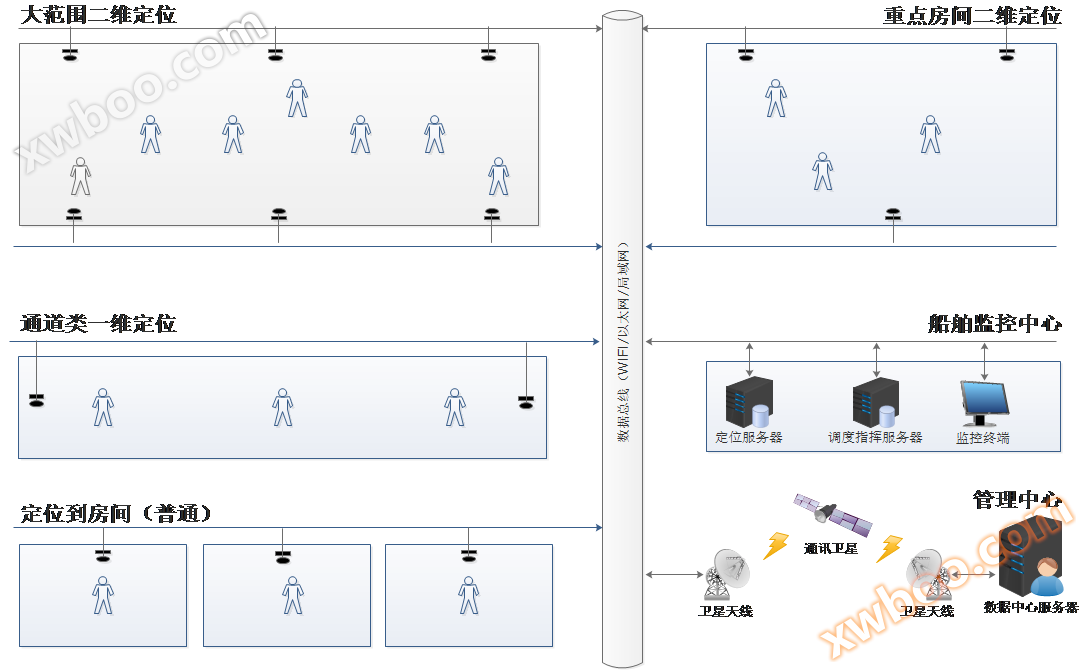
The overall structure of the system is shown in the diagram1As shown:
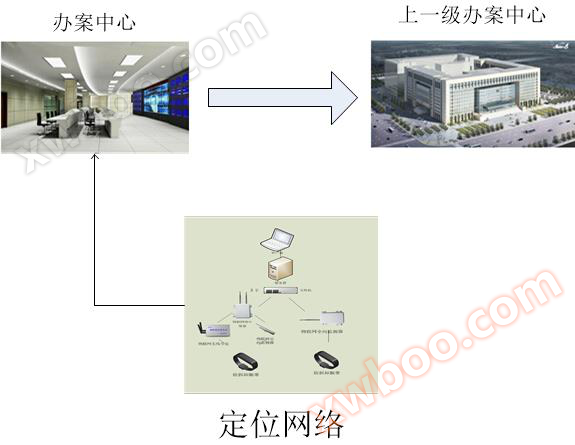
Figure 1 Overall structure diagram of the case handling center positioning system
4.2Design of Case Handling Center System
By arranging in the case handling centerRFIDAccurate positioning equipment can achieve precise control in every process. The process of the system includes: file entry, personal inspection, information collection, guarding for trial, questioning, etc. The system can link and record videos of each person involved in the case, providing technical assurance for rapid video verification,Once a problem occurs,The entire process can be video replayed, and for the recording points of the involved personnel, other technologies are currently unable to achieve it,Can protect the legitimate rights and interests of the parties involved,At the same time, it can also protect police officers,Prevent malicious complaints,Ultimately ensuring standardized law enforcement. The law enforcement place is equipped with a whole process audio and video recording system, an online video monitoring and supervision system, and a law enforcement and case handling place management system to monitor the whole process of reporting, entry, security inspection, personal belongings storage, personnel activities, rest, and food of suspect after entering the place, as well as the use of the place. Full process information recording, procedural management, and comprehensive supervision of various law enforcement security details in the case handling center.
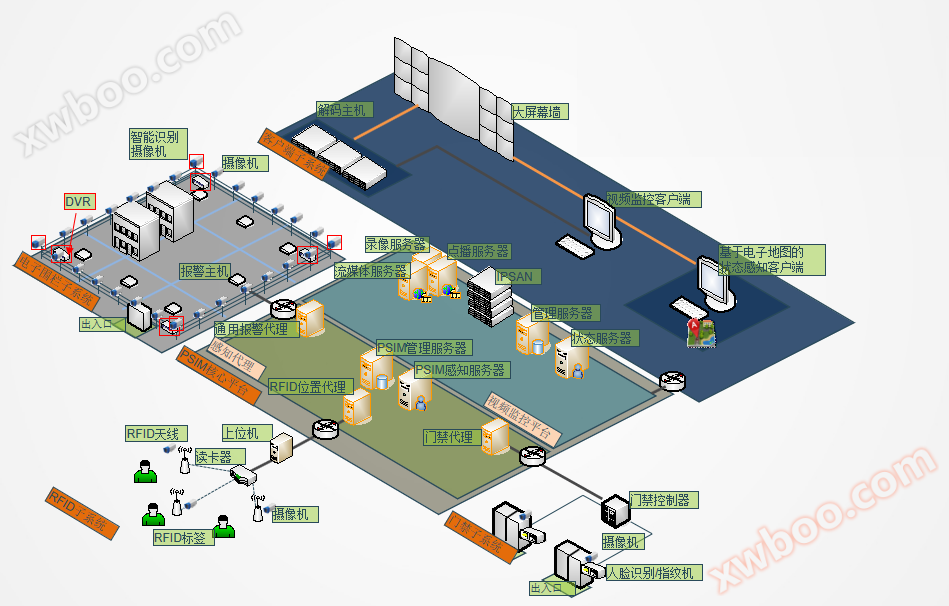
The hierarchical structure of the case handling center design is shown in the figure2As shown:
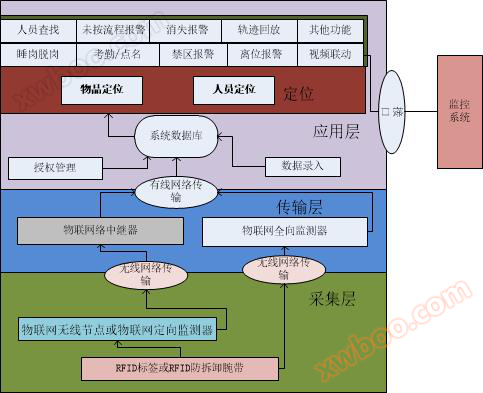
image2System Hierarchy Diagram
4.3system implementation
4.3.1System composition
The system consists of two parts: software and hardware. The software is the Beijing Zhikuan Information Case Handling Center positioning system.
The hardware of the physical evidence management system of Beijing Zhikuan Information Public Security Bureau mainly consists of communication links, RFID tags, IoT wireless nodes, IoT directional monitors, IoT omnidirectional monitors, IoT network repeaters, and communication links.
Communication links are divided into wireless links and wired links, and wireless links do not require additional hardware. It isRFIDBetween tags and wireless nodes in the Internet of ThingsRFIDBetween tags and IoT directional monitorsRFIDBetween tags and IoT omnidirectional monitors; The link between directional monitors or wireless nodes of the Internet of Things and IoT network repeaters, which exchanges and transmits information through radio frequency signals.
4.3.2Workflow of each layer of the system
4.3.2.1Collection Layer:
1) RFID tag: Each piece or group of evidence is bound to an RFID tag, and each RFID has a unique ID identifier. A one-to-one identification relationship is formed between the bound one-dimensional barcode and one or a group of evidence. RFID Each1sProactively transmit RF signals to the outside according to the prescribed protocol, including effective information such as tag ID number and tag battery level.
2) IoT wireless nodes: actively monitor the surrounding RF signals, add their own information to the protocol frame when receiving valid RFID signals, and then send out the information.
3) IoT directional monitor:The working principle is the same as that of wireless nodes in the Internet of ThingsHowever, the recognition range is relatively small, usually placed at the entrance and in narrow spaces to determine whether there is evidence passing through.
4)IoT Omnidirectional Monitor:Actively monitor the surrounding RF signals and use Ethernet orRS485The interface will receive unique information and its ownIDWait for the information to be transmitted to the backend application system for analysis. It is a device between the acquisition layer and the communication layer.
5)Handheld terminal: automatic storage.
4.3.2.2Transport Layer
IoT network repeater: actively monitors the surrounding RF signals, and when receiving effective information from IoT wireless nodes or IoT directional monitors, it is transmitted to the backend application system for analysis through Ethernet or RS485 transmission methods.
4.3.2.3application layer
Complete the processing of paired data collection and functional implementation.
4.3.4Overview of System Positioning Principle
Room positioning: Install an IoT wireless node in the room and install an IoT directional monitor at the door of the room. Due to the limited range of signals that can be received by the directional card reader, RFID signals are only received when they pass through the doorway. So only when the card reader bound to the room receives the RFID signal and the wireless IoT node bound to the room receives the RFID signal strength reaching a certain threshold, it is considered that the evidence bound to the RFID has been brought into the room. On the contrary, if and only if the IoT directional monitor bound to the room receives the RFID signal again and the strength of the RFID signal received by the IoT wireless node bound to the room decreases to a fixed threshold or even cannot receive the RFID signal, it is considered that the evidence bound to the RFID has been taken away from the room.
Corridor positioning: Install several IoT wireless nodes in the corridor based on the length of the corridor, and use a certain algorithm to locate the approximate location of the RFID bound evidence in the corridor by referring to the signal strength received by each IoT wireless node.
Staircase entrance: Install an IoT directional monitor at the staircase entrance. When the IoT directional monitor receives a tag signal and the IoT wireless nodes in the corridor adjacent to the staircase entrance cannot receive the RFID signal, it is considered that the evidence bound to the RFID has been taken away through this staircase entrance.
Building exit positioning: Install an IoT directional monitor at the building exit. When the IoT directional monitor reads the RFID signal, it is considered that the evidence bound to the RFID has passed through the entrance.
Chapter 5 System functions
5.1Real time positioning of personnel areas
Capable of real-time positioning of the area where personnel wearing location tags are located and displaying it on the monitoring map.
5.2Control personnel statistics and electronic roll call
Count the attendance and actual attendance in each region, as well as the actual attendance in a specific area, compare it with the expected attendance, and determine whether all personnel have arrived. And display the names of absent personnel.
5.3Personnel search
On the monitoring end, you can input a person's name or tag number to search for the current location of a specified person.
5.4Not following the process
The personnel involved in the case must follow the established process. If they do not follow the process and enter the next process before the previous process ends, the system will generate an alarm, and the area alarm will provide voice prompts.
5.5Individual inquiry, questioning
The questioning and interrogation of the involved personnel must be completed by two police officers at the same time. If one police officer conducts the interrogation, the system will report to the police within the specified time.
5.6 Off duty and sleeping on duty
Can monitor and remind duty personnel at night12:00Until dawn7:00Every half hour, the on duty police must conduct normal patrols, otherwise the system will generate audible and visual alarms.
5.7Disappearing alarm
Focus on monitoring certain tags, and when these tags leave the designated area or are cleared, the system will detect corresponding alarms.
5.8Cross border, leave and report to the police
Some areas are classified as important zones, and unauthorized personnel entering will trigger an alarm message It is also possible to set certain personnel not to leave within a set time in certain areas, and if they leave or disappear, the system alarm will be triggered .
5.9Playback of trajectory
You can query the movement trajectory of a certain tag during a specified time period, and which areas the tag has visited during this time period.
5.10Video linkage
Each positioning device can be bound with a camera, and by clicking on the positioning device map on the monitoring end, the video of the area where the positioning device is located can be called. When there is a specific alarm, the system will automatically call up the video of the area where the alarm occurred.
5. 11Temporary authorization of personnel
When a person needs to temporarily enter an important area or leave a scheduled travel area, temporary authorization can be granted in the system to allow them to enter the important area or leave the work area for a certain period of time.
5.12Electronic tag malfunction alarm
electronic biddingThe malfunction of the signature mainly refers to the low voltage of the label battery; The wristband worn by personnel has been damaged or removed;
As long as the wristband worn by the personnel is removed, the system will prompt an alarm; Whether it is cutting or dismantling with tools, the system will give an alarm. When the battery voltage on the label is too low, the system will also prompt that the battery needs to be replaced as soon as possible.
Chapter 6Product Introduction
6.1IoT directional monitor
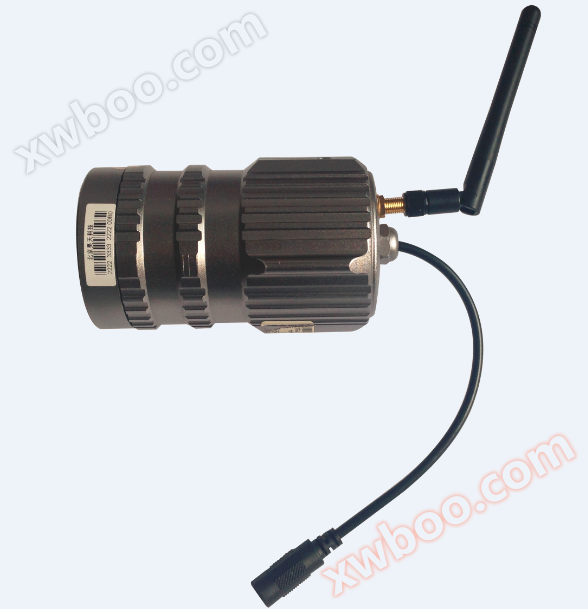
Ordering information:
HT-WDM-ZL(ZH)10(11/12/13/14•••)
Product Features:
working mode
The working mode of the reader/writer is "passive or active". Generally, when applied, the reader/writer is in a receiving state, receiving real-time signals from "active" electronic tags within the coverage range, and transferring the received data to the backend management system through IoT network repeaters. In special applications, data can also be written to tags or parameters can be changed.
Recognition distance
The reader/writer, in conjunction with the company's "active" electronic tags, can recognize within a good visual environment30The cone range is between ° -60 °, and the maximum recognition distance in one direction can reach50mThe optimal recognition distance is5-15mCompared with passive tags in specific applications, super strong signals and ultra long recognition distances have significant advantages. When users have different requirements for recognition distance or complex application environments, active electronic tags and readers with different signal strengths can be selected, and the gain of the readers can be adjusted through software to achieve the desired recognition distance.
recognition speed&ability
Active electronic tags are highest within the effective recognition range of the reader/writer200Km/hWhen running at high speed, it can ensure stable recognition. This feature can fully ensure the identification of personnel and items during high and low speed movements. The reader/writer can read simultaneously200Active electronic tags above Zhang, recognition accuracy99.999%It can ensure complete recognition without missing readings in a very short period of time. This feature is particularly suitable for personnel management in schools, large enterprises and institutions, as well as for large-scale asset monitoring, positioning, and warehouse management applications.
communication security
When the reader/writer communicates with the supporting active electronic tag, a special communication protocol is used to verify the legitimacy of the device. A comprehensive encryption algorithm has been developed to prevent data cracking and ensure data security during the communication process.
reliable operation
The product fully considers the requirements of industrial environment applications such as lightning protection, waterproofing, and impact resistance; The production process strictly followsISO9001Quality standards are controlled through multiple processes to fully ensure product performance and quality.
Interface standards
Wireless provided by IoT directional monitorzigbeeThe transmission module wirelessly transfers data to the backend management system through IoT network repeaters.
The company provides complianceWindosThe standard software interface for a series of operating system platforms, providing underlying communication protocols.
Application Scenario:
Regional positioning
The main application scope includes: hospitals, nursing homes, schools, tourism departments, industrial and mining areas, enterprises and institutions, research institutes, military units, prisons and other entrances, used for entry and exit judgment and entrance passage points.
Asset monitoring
The scope includes: entry and exit management of classified assets, valuable items, storage and circulation assets, etc.
Product Parameters:
Parameters/Model |
HT-WDM-ZL(ZH)10(11/12/13/14•• |
Recognition distance |
0-50m radius |
recognition speed |
200 kilometers per hour |
Identification ability |
Simultaneously identify over 200 tags |
Identify angles |
Directional recognition |
polarization mode |
Vertical polarization or dual polarization+physically limited direction |
Gain |
5dBi with 32 levels of adjustable reception and 4 levels of adjustable transmission |
operating frequency band |
2.4 GHz ~ 2.4835 GHz |
Power consumption standard |
The working power is in the milliwatt range |
communication mechanism |
Based on HDLC time-division multiple access and synchronous communication mechanism |
anti-interference |
Channel isolation technology, multiple devices do not interfere with each other |
Security |
Encryption calculation and security authentication to prevent link detection |
Interface standards |
Basic configuration: Zigbee, RS485 optional |
Expand I/O |
Two channels of switch signal input and output (optional) |
Power standard |
DC 7.5~12V 500~2000mA |
Environmental Requirements |
Temperature: -40 ℃ -85 ℃, humidity: 5% RH -95% RH (no condensation) |
Packaging characteristics |
Stainless steel shell packaging |
Reliability |
Lightning protection, waterproofing, and impact resistance meet the requirements of industrial environments |
Size |
180 × 135 × 60 mm (excluding antenna) |
Weight |
0.58kg |
Installation method |
Bracket, clamp |
6.2IoT network repeater
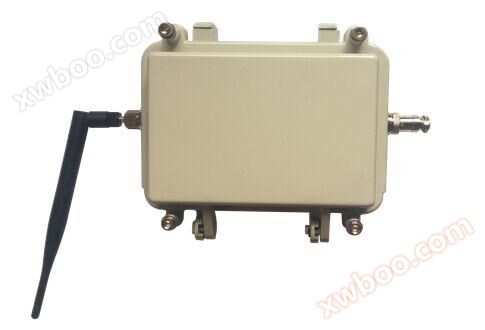
Ordering information:
HT-WIT-ZL(ZH)10(11/12/13/14•••)
Product Features:
working mode
The working mode of IoT network repeaters is "passive or active". Generally, when applied, IoT network repeaters are in a receiving state, receiving real-time signals from "active" IoT wireless nodes and IoT directional monitors, and forwarding the received data to the backend management system. In special applications, increasing the output switch signal can control the alarm lights and bells, as well as control the on/off of access control. It can also send commands to the sound and light alarm tags, and the controller can light up and alert the location of the alarm.
Recognition distance
The combination of the reader and the company's "active" active electronic tag can achieve a maximum recognition distance of100mRadius. Compared with passive tags in specific applications, super strong signals and ultra long recognition distances have significant advantages. When users have different requirements for recognition distance or complex application environments, active electronic tags and readers with different signal strengths can be selected, and the gain of the readers can be adjusted through software to achieve the desired recognition distance.
recognition speed&ability
Active electronic tags are highest within the effective recognition range of the reader/writer200Km/hWhen running at high speed, it can ensure stable recognition. This feature can fully ensure the identification of personnel and items during high and low speed movements. The reader/writer can read simultaneously500Active electronic tags above Zhang, recognition accuracy99.999%It can ensure complete recognition without missing readings in a very short period of time. This feature is particularly suitable for personnel management in schools, large enterprises and institutions, as well as for large-scale asset monitoring, positioning, and warehouse management applications.
communication security
When the reader/writer communicates with the supporting active electronic tag, a special communication protocol is used to verify the legitimacy of the device. A comprehensive encryption algorithm has been developed to prevent data cracking and ensure data security during the communication process.
reliable operation
The product fully considers the requirements of industrial environment applications such as lightning protection, waterproofing, and impact resistance; The production process strictly followsISO9001Quality standards are controlled through multiple processes to fully ensure product performance and quality.
Interface standards
The reader/writer can provideRS485 weigand26 RJ45 TTLWaiting for standard hardware interfaces. If requiredRS232orWiFiPlease specify when ordering when waiting for the interface.
The company provides complianceWindosThe standard software interface for a series of operating system platforms, providing underlying communication protocols.
Application Scenario:
Regional positioning
The scope of RTLS personnel area positioning (monitoring) system includes personnel area positioning and management applications such as tracking and monitoring in hospitals, nursing homes, schools, tourism departments, industrial and mining, enterprises and institutions, research institutes, military units, prisons, etc.
Asset monitoring
The scope of RTLS asset monitoring (area positioning) system includes: classified assets, valuable items, and storage and circulation assets.
Product Parameters:
Parameters/Model |
HT-WWL-ZL(ZH) 10(11/12/13/14) |
Recognition distance |
0-100m radius |
recognition speed |
200 kilometers per hour |
Identification ability |
Simultaneously identify more than 500 tags |
Identify angles |
omnidirectional |
polarization mode |
Vertical polarization or dual polarization |
Gain |
5dBi with 32 levels of adjustable reception and 4 levels of adjustable transmission |
operating frequency band |
2.4 GHz ~ 2.4835 GHz |
Power consumption standard |
The working power is in the milliwatt range |
communication mechanism |
Based on HDLC time-division multiple access and synchronous communication mechanism |
anti-interference |
Channel isolation technology, multiple devices do not interfere with each other |
Security |
Encryption calculation and security authentication to prevent link detection |
Interface standards |
RS232、RS485、Wiegand26、RJ45、TTL、WiFi 等可选 |
Expand I/O |
Two channels of switch signal input and output (optional) |
Power standard |
DC 7.5~12V 500~2000mA |
Environmental Requirements |
Temperature: Humidity: |
Packaging characteristics |
Aluminum alloy shell packaging |
Reliability |
Lightning protection, waterproofing, and impact resistance meet the requirements of industrial environments |
Size |
180 × 135 × 60 mm (excluding antenna) |
Weight |
0.58kg |
Installation method |
U-shaped and L-shaped specialized metal installation kits |
6.3 RFIDAnti disassembly electronic wristband
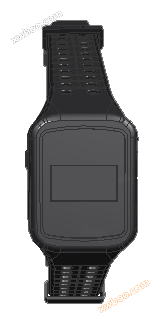
Ordering information:
HT-ZHR-BL 10(11/12/13/14•••)
Product Features:
working mode
The tag operates in an "active mode" and actively transmits signals to the reader/writer. The transmission frequency is adjustable. The tag uses a high-energy button type lithium battery with optional capacity inside. Under standard conditions, the energy provided by the battery can ensure continuous operation of the tag8-16A month.
Recognition distance
The company's reader/writer is paired with the "active" active electronic tag. Compared with passive tags, active tags have significant advantages in terms of strong signals and long recognition distances in specific applications. In a good visual environment, the maximum recognition distance can reach150m.
When users have different requirements for the length of recognition distance, or when the application environment is complex, they can choose to use active electronic tags and readers with different signal strengths, and can change the gain value of the readers through system software to achieve the desired recognition distance.
recognition speed&ability
The reader/writer can read simultaneously200Active electronic tags above Zhang, recognition accuracy99.999%It can ensure complete recognition without missing readings in a very short period of time. This feature is particularly suitable for personnel management in schools and large enterprises, as well as for large-scale asset monitoring and warehouse management applications.
communication security
When active electronic tags communicate with the accompanying reader/writer, a special communication protocol is used to verify the legitimacy of the device. A rigorous encryption algorithm has been developed to prevent data cracking and ensure data security during the communication process.
reliable operation
The product fully considers the requirements of industrial environment applications such as lightning protection, waterproofing, and impact resistance; The production process strictly followsISO9001Multi stage quality testing is conducted according to quality standards.
Interface standards
comply withISO18000-4Standard specifications.
Application Scenario:
asset management
Used for personnel positioning function and monitoring the movement of personnel.
Product Parameters:
Parameters/Model |
HT- ZHR -BL 10(11/12/13/14•••) |
Recognition distance |
Adjustable from 0 to 150m |
recognition speed |
200 kilometers per hour |
Identification ability |
Equipped with anti-collision performance of 200 frames per second |
Identify angles |
Omnidirectional identification |
COMMUNICATION RATE |
1Mb/s |
Gain |
Levels 0-3 can be selected as needed |
operating frequency band |
2.4 GHz ~ 2.4835 GHz |
Power consumption standard |
The working power is in the micro watt level |
measurement range |
Gyroscope sensor: ± 300 °/sec; Acceleration sensor: ± 2g |
sensitivity |
Gyroscope sensor: ± 1 °/sec/LSB; Acceleration sensor: ± 10-5g |
communication mechanism |
Based on HDLC time-division multiple access and synchronous communication mechanism |
anti-interference |
10V/M 0.1-1000MHz AM amplitude modulated electromagnetic waves, channel isolation technology, multiple devices do not interfere with each other |
Security |
Encryption calculation and security authentication to prevent link detection |
Read and write function |
176B storage space (optional) |
tamper device |
Anti disassembly alarm function (optional) |
Battery configuration |
Button type lithium manganese battery, capacity 500mAh |
Environmental Requirements |
Working temperature -40 ℃~85 ℃ Working humidity<95% |
Packaging characteristics |
ABS engineering plastic, resistant to high-strength drop and vibration |
Reliability |
Lightning protection, waterproofing, and impact resistance meet the requirements of industrial environments |
Size |
125×15×12 mm |
Weight |
30g |
6.4 RFIDPrison guard electronic tag
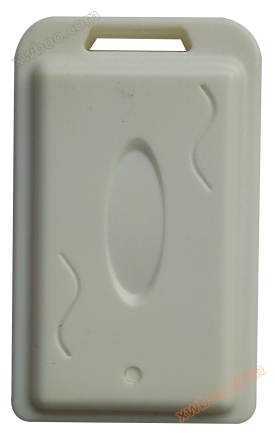
Ordering information:
HT-ZHR-BL
Product Features:
working mode
The tag operates in an "active mode" and actively transmits signals to the reader/writer. The transmission frequency is adjustable. The tag uses a high-energy button type lithium battery with optional capacity inside. Under standard conditions, the energy provided by the battery can ensure continuous operation of the tag8-16A month.
Recognition distance
The company's reader/writer is paired with the "active" active electronic tag. Compared with passive tags, active tags have significant advantages in terms of strong signals and long recognition distances in specific applications. In a good visual environment, the maximum recognition distance can reach150m.
When users have different requirements for the length of recognition distance, or when the application environment is complex, they can choose to use active electronic tags and readers with different signal strengths, and can change the gain value of the readers through system software to achieve the desired recognition distance.
recognition speed&ability
The reader/writer can read simultaneously200Active electronic tags above Zhang, recognition accuracy99.999%It can ensure complete recognition without missing readings in a very short period of time. This feature is particularly suitable for personnel management in schools and large enterprises, as well as for large-scale asset monitoring and warehouse management applications.
communication security
When active electronic tags communicate with the accompanying reader/writer, a special communication protocol is used to verify the legitimacy of the device. A rigorous encryption algorithm has been developed to prevent data cracking and ensure data security during the communication process.
reliable operation
The product fully considers the requirements of industrial environment applications such as lightning protection, waterproofing, and impact resistance; The production process strictly followsISO9001Multi stage quality testing is conducted according to quality standards.
Interface standards
comply withISO18000-4Standard specifications.
Application Scenario:
asset management
Used for personnel positioning function and monitoring the movement of personnel.
Product Parameters:
Parameters/Model |
HT- ZHR -BL 10(11/12/13/14•••) |
Recognition distance |
Adjustable from 0 to 150m |
recognition speed |
200 kilometers per hour |
Identification ability |
Equipped with anti-collision performance of 200 frames per second |
Identify angles |
Omnidirectional identification |
COMMUNICATION RATE |
1Mb/s |
Gain |
Levels 0-3 can be selected as needed |
operating frequency band |
2.4 GHz ~ 2.4835 GHz |
Power consumption standard |
The working power is in the micro watt level |
measurement range |
Gyroscope sensor: ± 300 °/sec; Acceleration sensor: ± 2g |
sensitivity |
Gyroscope sensor: ± 1 °/sec/LSB; Acceleration sensor: ± 10-5g |
communication mechanism |
Based on HDLC time-division multiple access and synchronous communication mechanism |
anti-interference |
10V/M 0.1-1000MHz AM amplitude modulated electromagnetic waves, channel isolation technology, multiple devices do not interfere with each other |
Security |
Encryption calculation and security authentication to prevent link detection |
Read and write function |
176B storage space (optional) |
tamper device |
Anti disassembly alarm function (optional) |
Battery configuration |
Button type lithium manganese battery, capacity 500mAh |
Environmental Requirements |
Working temperature -40 ℃~85 ℃ Working humidity<95% |
Packaging characteristics |
ABS engineering plastic, resistant to high-strength drop and vibration |
Reliability |
Lightning protection, waterproofing, and impact resistance meet the requirements of industrial environments |
Size |
125×15×12 mm |
Weight |
25g |
Similar Product Recommend