-
E-mail
china_zhikuan@163.com
- Phone
-
Address
213, 2nd Floor, Building 5, No.16 Junying Street, Shunyi District, Beijing
Product Categories
Beijing Zhikuan Information Technology Co., Ltd

Smart Detention Center Personnel Positioning Management
NegotiableUpdate on 09/17
- Model
- Nature of the Manufacturer
- Producers
- Product Category
- Place of Origin
Overview
On March 1, 2009, two inmates from Hanzhong Prison in Shaanxi Province escaped after sawing through the workshop's sewer isolation network in the Smart Detention Center Personnel Positioning Management Chapter 1 System Overview
Product Details
Smart Detention Center Personnel Positioning Management
Chapter 1 System Overview
2009year3moon1On the same day, two inmates from Hanzhong Prison in Shaanxi Province escaped after sawing through the workshop's sewer isolation net.
2009year5moon23On the day, the Jieshou City Detention Center in Anhui Province3The detainees escaped.
2009year10moon17Day, Hohhot Prison4A prisoner escaped from prison after killing a prison guard.
2009year11moon15On that day, Liu Hong, a severe criminal from Deshan Prison in Changde, Hunan, escaped.
2010year1moon6A suspect escaped during treatment in Qinzhou, Guangxi, Sunday.
2011year10moon25Escape from Henan Yubei Prison2011
2011year9moon11Escape from Shenzhou Prison in Hebei Province2011
2014Yanshou County Detention Center in Heilongjiang Province3A prisoner killed a police officer and escaped from prison.
Due to the relatively lagging informationization construction of prison management, a series of vicious incidents similar to the above-mentioned cases continue to occur throughout the country, causing great harm to the country and the people. To prevent the recurrence of police attacks and escape incidents, and to prevent detainees from endangering society again, the intelligent construction of prisons is urgent.
Starting from the urgent needs of prison management for detainees, Beijing Haotian Technology utilizes the latest technologyRFIDTechnology has proposed a smart prison defense management system, which aims to improve the informatization of prison area management, promote the institutionalization of prisoner management, ensure the security and stability of prison defense, and maintain social stability and harmony.
Chapter 2System overall scheme design
2.1 Guiding ideology for smart prison defense system
The construction of a smart prison defense system aims to improve the level of informationization in prison management, ensure the safety of prison staff, and prevent escape incidents. With the promotion and comprehensive application of the Internet of Things as the core, and the goal of high quality, low investment, and simplified processes, the system design and overall planning are carried out within the overall framework of digital informationization prison construction. Following the overall construction concept of "scientific coordination, key emphasis, gradual improvement, and perfection", the informationization and modernization process of prison personnel management and administrative management in China is comprehensively promoted. The system construction aims to improve the informatization level of prison management work and prevent prison escape incidents, with the focus on achieving real-time, efficient, and scientific prison management work. The promotion and comprehensive application of information systems are the core, and low investment, high efficiency, and quality are the goals. Within the overall framework of digital information prison construction, the system design and overall planning are carried out. Following the overall construction concept of "overall planning, step-by-step construction, simultaneous construction and use, and gradual improvement", the informationization and modernization process of prison personnel management and administrative management work are comprehensively promoted.
The system development and construction follow the following principles:
2.1.1Global planningindependent innovation
The smart prison defense management system mainly consists of seven subsystems: personnel basic information management system, card reader electronic tag management system, electronic map positioning management system, monitoring system, access control system, medical parole system, and personnel attendance evaluation system. On the basis of the existing regulatory system, deepen the application of functions, integrate personnel positioning system, and achieve a security and defense one card system.
Haotian Technology focuses on the promotion of Internet of Things technology and the application of ZigBee technology. It has independently developed and created a smart prison defense management system, which uses the market's commonly used 2.4G frequency band communication and establishes its own unique communication protocol and algorithm encryption mechanism to protect data security, ensure communication stability, and ensure customer satisfaction.
2.1.2Standardize the system and take a broad viewfuture
The development and resource construction of the smart prison defense management system comply with unified technical specifications and characterization systems, emphasizing the continuity and sharing of development work, and leaving standardized data and control interfaces for the subsequent development and promotion of the system. Unified development of application technology, data storage format, signal transmission standard, interconnection interface mode and other technical indicators; In terms of overall system architecture, selection of service equipment, types of electronic tags for card readers, and basic data collection, full consideration is given to the implementation of subsequent functions, taking into account device compatibility, system scalability, functional scalability, and application diversity.
2.2 System Principles
The smart prison defense management system utilizes advanced ZigBee and RFID technologies to use the globally unique ID number smart monitoring wristband as an identification device for detainees. Its features include anti disassembly, long communication distance, waterproof, reliable data, and long service life, effectively meeting the business needs of prison management. Management personnel can visually display the status of the entire prison through the backend server and have a clear understanding of the situation.
The IoT network directional monitor is used at the entrance of the detention facility to assist in locating and determining the entry and exit management of detainees; IoT wireless nodes are used in monitoring buildings and corridor areas to achieve full signal coverage in monitoring areas; The IoT repeater is a key point for data transmission, which transmits the received data from the IoT network directional monitor and IoT wireless nodes to the backend server through Ethernet or 485 cables.
2.2.1Working principle of electronic tags
Electronic tag (RFID) technology is a wireless radio frequency automatic identification technology that utilizes radio frequency signals and their spatial coupling and transmission characteristics to achieve automatic machine recognition of stationary or moving items to be identified. In the system, electronic tag technology is used to develop and produce electronic wristbands and prison guard cards.
The RFID system generally consists of three parts, namely electronic tags, readers, and backend management software. In applications, electronic tags are attached to items, devices, or personnel to be identified. When the identified items, devices, or personnel with electronic tags enter the reading range of the reader, the reader automatically receives the agreed identification information in the electronic tag wirelessly or writes specific information, thereby achieving the function of automatically identifying items or collecting item identification information.
2.2.2 RFIDPrinciples of Automatic Recognition Technology
RFIDThe system composed of short-range communication devices mainly includes two parts: intelligent RFID and RFID Read Write Units (RWUs). The wireless communication between RWUs and RFID enables information exchange between the information management system and RFID.
RWU is an RFID reader/writer controller, consisting of a microprocessor, a security module, a microwave communication controller, and communication interfaces such as RS232, 485, TCP/IP. It uses short-range communication protocols and microwave wireless transmission methods to achieve secure and reliable information exchange between RWU and RFID. RWU is connected to the upper computer through RS232, 485, WIFI, GPRS, TCP/IP, etc., receives control commands and data from the upper computer, and returns data.
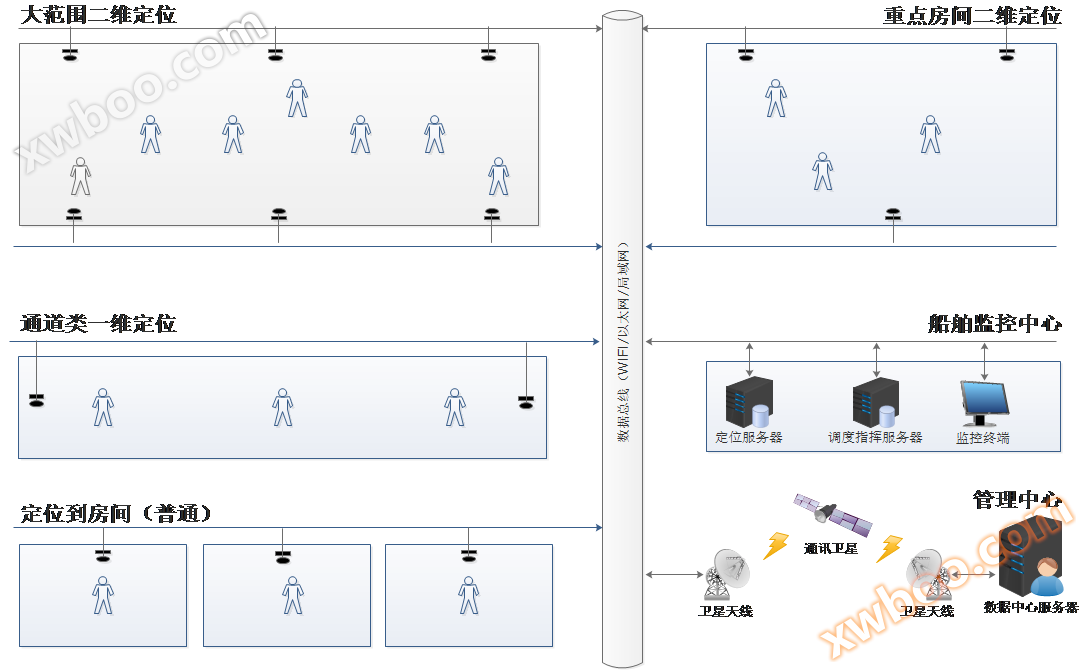
3.1 System overall design drawings
Overall design drawings of the prison system
Note: The design of the entire prison includes three parts: the perimeter area of the prison wall, internal areas such as production workshops and living quarters, and non room areas within the wall. These three parts are independent and closely related to each other, forming three prison security prevention systems together.
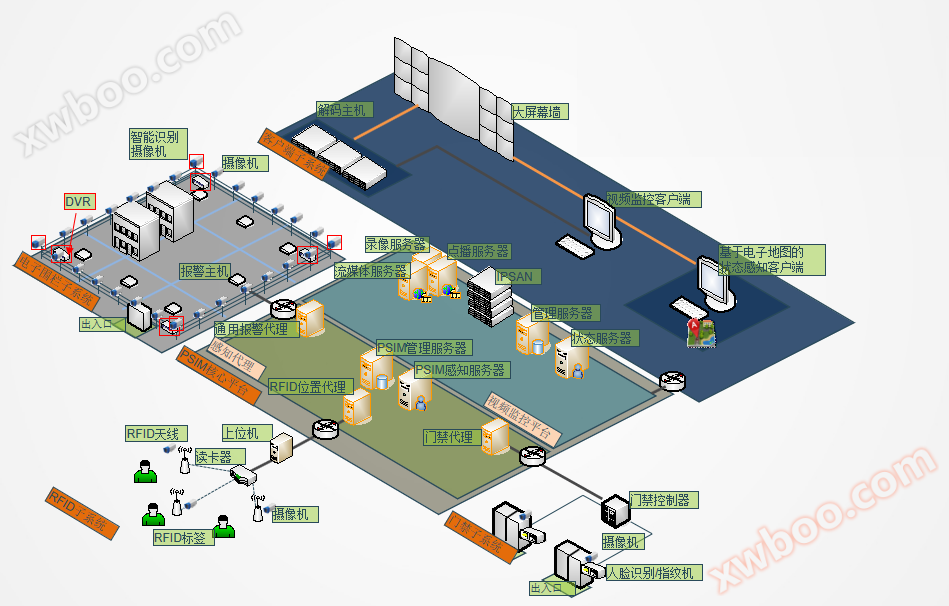
3.2 Software system architecture
Software system architecture
Chapter 3Overview of System Solutions
The overall planning is the top priority for the construction of intelligent management and security prevention systems in prisons. Our company has conducted a detailed investigation of recent prison escape incidents and divided the construction of intelligent management and security prevention systems in prisons into three parts based on the work processes of prison guards and the activity patterns of inmates: the intelligent management system in the prison area and the construction of the security prevention system outside the prison areaactivity areaIntelligent management system, intelligent management of medical parolesystemThe three parts complement each other and jointly build an intelligent management and security prevention system for prisons.
We will explain in detail the three components of prison intelligent management and security prevention system:
5.1 Intelligent management system for monitoring areas
The construction of intelligent management system for prison areas mainly includes the following parts: 1. perimeter management system for prison walls, production areas, living areas, etc; 2. Access control and real-time positioning system for living areas, production areas, restaurants, and monitoring facilities; 3. Outpost and Armed Police Gun Management System;
1)Perimeter management system for prison walls, production areas, living areas, etc
a prison wall
The prison wall is the last line of security for the intelligent management and security prevention system of the prison, which prevents the detention of prisoners
The most important checkpoint for personnel to escape from prison plays a decisive role in the safety of the entire prison system. Therefore, there are extremely high requirements for the stability, timeliness, and anti-interference of equipment. In order to ensure the stable operation of the system, we have fully considered the design of the plan.
The prison perimeter management system consists of electronic fences or leaky cables, and the alarm host communicates through the personnel positioning management system to transmit to the monitoring center
Prison perimeter function: prevent detainees from escaping; When the detained person approaches the electronic fence about 3 meters away (with an error of no more than 50 centimeters), the alarm device will automatically activate the alarm, and the large screen will display the scene of the incident - the identity and location information of the detained person who entered the restricted area, and view the scene online through video linkage function;
Installation method for prison perimeter: Buried shallowly along the middle of the wall or 30 centimeters away from the wall (the perimeter cable antenna needs to be covered with PVC pipe to prevent bending, deformation, and corrosion by water). Install a perimeter IoT directional monitor and a waterproof testing electronic tag every 50 meters (which can be detected in the background when the IoT directional monitor is damaged to ensure stable operation of the IoT directional monitor). Install a directional reader as a signal receiver every 80 meters.
Production area, living area, etc
The boundaries of production and living areas also need to be equipped with IoT directional monitors, perimeter IoT directional monitors, and perimeter cable antennas to prevent detainees from entering illegal areas without permission and prevent accidents from occurring; Prison guards and senior prison leaders in the monitoring center can set boundaries according to actual needs, such as how far away detainees are from the boundary to report to the police, how far detainees are not allowed to enter a certain area during a certain period of time, and how detainees can enter the perimeter to clean the lawn during a certain period of time;
2)Outpost and Armed Police Gun Management System
The construction of the sentry and armed police gun management system includes two parts: first, the sentry and armed police gun intelligent monitoring subsystem; Secondly, the real-time tracking and positioning management subsystem for perimeter prison guards' patrols;
◇ Outpost Armed Police Gun Intelligent Supervision Subsystem
Construction Plan of Intelligent Monitoring Subsystem for Armed Police Firearms at Outpost
Install a signal receiver and an IoT directional monitor inside or at the top of each sentry post, responsible for receiving electronic tags of armed police firearms and emergency distress signals issued by the armed police (such as detainees snatching firearms, detainees fighting, detainees exhibiting abnormal behavior, etc.), and transmitting the information to the backend monitoring center through the RJ45 network; Special electronic tags are installed on the gun stocks of the armed police. The electronic tags will send real-time electronic tag signals to the signal receiver. If the information sent by the electronic tags cannot be detected in the background for a period of time (such as 5 seconds, 10 seconds, etc.), the monitoring center alarm system and security monitoring system will automatically start. At this time, the LCD screen will display the current situation at the sentry post, the identity information of the on duty armed police, and the location information of the on duty armed police. The monitoring center can dispatch nearby armed police to assist in handling emergencies according to the actual situation, in order to prevent serious situations from occurring.
◇ Perimeter Armed Police Patrol Real time Tracking and Positioning Management Subsystem
Real time tracking system function for perimeter armed police patrol:
1)Regional positioning can be achieved through the installation of IoT directional monitors and signal receivers on the walls to achieve non precise regional positioning
2)Firearms and armed police off position alarm
3)Armed police officers carrying guns did not patrol according to the scheduled route, and the system reported an alarm
4)The armed police encountered an emergency situation and called the police for help
5)Tracking replay of armed police and firearms
3)Real time positioning system for access control areas such as living quarters, production areas, restaurants, and monitoring facilities
The real-time positioning system for access control areas such as living quarters, production areas, restaurants, and monitoring facilities includes two parts: first, the area access control management system; Secondly, regional real-time positioning system;
Regional access control management system
Survey on the Current Status of Access Control Management: Detainees are led by their team leaders and registered for entry and exit through the only channel provided by the internal and external security guards when they travel from the living area to the production area for work, dining in restaurants, or returning from the production area to the living area. At present, manual registration and counting of personnel are used, and the workload of prison guards is very high. Through the regional access control management system, the roll call data can be directly transmitted to the prison guards' PDAs or backend monitoring centers via LAN, WIFI, GPRS, etc., thereby reducing the workload of the guards.
Regional access control management system function: real-time roll call and specific permission settings for detainees passing through the gate (main gate) from the prison living area to the work and production area, restaurant, cell, etc. (a certain prisoner can only pass through the access control within the specified time, otherwise it will trigger an alarm), in order to strengthen the standardization and security of prison management;
Install IoT directional monitors and signal receivers in the channels between the living and production areas (determined by the on-site environment). As this channel is the only way for all detainees to enter or return to the production area, with a large daily flow of people, IoT wireless nodes are placed in the channel for higher system reliability;
The system will automatically record all information related to the entry and exit of detainees (including personal information, quantity, and entry and exit time), and can automatically match it with the rules of the backend system. When detainees who do not meet the passing rules pass through, the duty room will immediately sound and light an alarm and record any violations.
◇ Real time regional positioning system
The regional real-time positioning system is mainly used for comprehensive monitoring of personnel in large areas such as prison living areas, work areas, and activity areas. Through the combination of IoT omnidirectional monitors, IoT directional monitors, IoT wireless nodes, and IoT network repeaters, it monitors the production areas, activity areas, etc. in all directions, and real-time understands the detailed situation of detainees and prison guards. It can intuitively understand the actual number of personnel and personnel information in the area. Through software, it can be clear at a glance, greatly reducing the workload of prison guards and achieving a way to obtain scientific and technological police force.
Signal coverage is achieved through the combination of IoT omnidirectional monitors and directional positioning receivers in indoor and outdoor workplaces, key monitoring buildings, bathrooms, squares, and other areas;
The system will roll call the detainees within the designated area every 5-10 seconds (adjustable). When the detainees leave the designated area, the system will immediately sound an alarm and display the location of the alarm as well as information about the violating detainees.
The system can also impose controlled restrictions on various areas based on the event period. If someone enters the area during the controlled time period, the system will immediately sound and light an alarm to notify nearby prison guards to handle it in a timely manner, greatly avoiding the occurrence of unexpected situations. The setting of the controlled time can be flexibly changed according to prison regulations.
5.2 Intelligent construction of medical service institutions outside the supervision area
The overall construction of intelligent management and security prevention systems in prisons needs to take into account the intelligent construction of medical service institutions for detainees on parole. In recent years, there have been incidents of prisoners escaping from prison with the help of parole. These painful lessons have warned us that we cannot ignore all aspects of the supervision of detainees.
Considering the cost of intelligent construction for the entire prison staff and the special nature of medical service institutions outside the prison area, the intelligent construction of medical service institutions outside the prison area can adopt a key control, future oriented, and gradually improved policy, such as installing positioning devices at building entrances and exits, inter floor passages, electronic fences, hospital gate entrances and exits, etc., to prevent accidents from occurring;
5.3 Intelligent construction of outdoor location monitoring
The intelligent construction of outdoor location monitoring mainly refers to the remote RFID monitoring, positioning, tracking, and roll call mode adopted for temporary outdoor work areas and internal areas of driving vehicles for detainees to work outside and seek medical treatment on parole, in order to obtain police force from technology.
Install an omnidirectional reader or PDA handheld device on the roof or inside of the police car to monitor overlapping areas in real time through a combination of methods, and transmit monitoring information back to the prison information center in real time through the GPRS network.
When seeking medical treatment on parole or working outside the area, the reader will transmit real-time information on the number, identity, and prison guards of detainees to the prison information center, so that the information center can keep track of the movements of detainees at any time;
When working outside, the boundary should first be designed through a police car. When the labor reform personnel approach the perimeter, the system will sound an alarm, display it on the terminal inside the car, and transmit the relevant information back to the prison information center;
Labor reform personnel need to work within the designated area, and the system will regularly report their location information;
Prison guards should promptly send distress signals in case of emergency, which are transmitted to the backend through GPRS network to prevent accidents from occurring;
The system sets locators according to the interval area, and the locators are powered by batteries and can be flexibly configured for movement.
Chapter FourFeatures
The Smart Prison Defense Management System is currently the most advanced prison management system, which involves functions that effectively meet the business needs of prisons and facilitate the daily management work of management personnel, such as real-time positioning, cross-border alarm, unauthorized departure alarm, wristband disassembly alarm, video linkage, etc., as follows:
3.1.1Real time monitoring of personnel
Real time display of all detainees and police positions on the electronic map, allowing monitoring personnel to dynamically grasp the number and real-time distribution of personnel. By hovering over the personnel icon with the mouse, detailed information about the personnel can be viewed.
3.1.2Personnel search and location
Enter the name or number of the personnel to quickly locate the location of the criminal or police officer to be searched for.
3.1.3Illegal gathering alarm
In the designated area, the system can set the maximum allowed number of personnel, and once the preset number is exceeded, an alarm message will be immediately issued.
3.1.4Restricted area intrusion alarm
Detainees illegally entering the restricted area will automatically sound an alarm in the background. Some areas are restricted zones (such as fence warning areas, hazardous material source areas, etc.), and unauthorized detainees illegally enter the backend system, which automatically alarms and pops up a video window of the incident site; At important checkpoints in prisons, permission and time period permissions can be pre-set, and unauthorized personnel entering or leaving the checkpoint will automatically trigger an alarm.
3.1.5Unauthorized departure alarm
It is stipulated that certain prisoners cannot leave a certain area or designated location during a certain period of time, and once they leave, an alarm will be issued.
3.1.6Activity trajectory record
The system records all personnel's passing locations and times around the clock, and can track and replay their movement routes to grasp their detailed activity routes and times.
3.1.7Automatic room inspection and roll call
It can automatically count the number of personnel in each prison building on a scheduled basis, presenting the exact number of people who should have arrived, the number of people who have arrived, and the number of people who have not arrived. If the personnel have not arrived, an alarm will be issued in a timely manner to remind the prison guards to locate the missing personnel and prevent unexpected situations from happening. The prisoner has already set the room number in the system, and once the prisoner enters the wrong room or leaves the room at an irregular time, an alarm message will also be issued.
3.1.8Escaping supervision and reporting to the police
Bind the prisoner's location tag with the police's location tag, which can be done one-to-one or many to many. When the walking trajectories of the prisoner and the police are inconsistent for more than the allowed time, the system will issue an alarm message. Or limit the distance between the prisoner and the police, and when the distance exceeds the specified limit, the system will issue an alarm message.
3.1.9Emergency call for help
The prison guards and prisoners' location tags have alarm buttons. In case of an emergency, the alarm button can be pressed, and the monitoring center can receive the alarm information in a timely manner, know the location of the caller, and quickly provide support.
3.1.10One card function
One card function, the prison electronic wristband is equipped with a non-contact one card chip. Prison guard cards can achieve access control, electronic door locks, inspection, attendance, and internal consumption functions, while electronic wristbands for detainees can achieve functions such as dining and internal consumption;
3.1.11Powerful statistical and reporting functions
The query statistics and reporting functions enable the management system to automatically generate various charts that are suitable for daily management by managers, including bar charts, pie charts, curve charts, lists, etc. These charts can conveniently assist prison managers in analyzing and statistically analyzing a section
The work and activities of various personnel since the period, as well as the occurrence and frequency of various alarm eventsVarious factors necessary for prison management, such as the location and cause of the occurrence.
3.1.12Armed Police and Their Departure Report
The police and armed police, as well as those who leave their positions, will immediately trigger the alarm if unauthorized armed police and firearms are forcibly taken out of the surveillance area;
3.1.13Video linkage
Video linkage, real-time online on site; Monitoring probes are installed in guard posts, monitoring buildings, production areas, living areas, leisure areas, etc. The probes work 24/7 and the information is stored in real-time in hard disk storage. When the reader receives a special messageIDWhen prison guards illegally remove firearms, detainees break into unauthorized areas, or prison guards are beaten, a command is sent to the backend service manager, which will pop up a video box on the software. The management personnel can immediately query the location and on-site situation of the abnormal situation to avoid the occurrence of dangerous situations;
3.1.14Remote monitoring and inspection
The system can be operated through the Internet to achieve remote management and monitoring, and the management personnel can check the prison situation at any time even if they are not in prison.
3.2Regional prison guard personnel management system
Each prison guard in the area is issued with active tags that record relevant information about the personnel, such as their name, gender, date of birth, department, level, image, entry and exit history, and access permissions; Install fixed card readers at the entrance of the area to monitor the entry and exit of prison guards. When someone approaches the gate, the card reader will first sound an alarm to alert the security guard that the prison guard is about to leave the surveillance area. Then the card reader recognizes the tag and transmits the data to the terminal upper computer in the security room. The upper computer will display the specific information of the person, such as name, image, etc. If necessary, relevant data can be sent to the main control center; Install a certain number of fixed card readers in the area to achieve regional positioning for prison guards. The number of card readers placed is arranged according to the on-site measurement area (each card reader has a certain recognition range and can only recognize the surrounding area):
3.2.1Accurate regional positioning
The system can achieve regional positioning and locate personnel within a controlled area. Due to the presence of readers and writers scattered throughout the area, each region is within the signal range of the fixed readers and writers. Therefore, all electronic tags within the region can be covered by the information of the readers and writers, thus achieving regional positioning;
3.2.2Strict access control
A fixed card reader is installed at the entrance of the area. Personnel need to leave the area, and the security guard can only release them after receiving approval from two specific leaders. Otherwise, personnel are prohibited from leaving the area. Personnel go out, the reader records the time of departure, and records and notifies the person of the time of return. If the card reader fails to read the person's return information within the specified return time, the system will alert the security guard and relevant personnel.
3.2.3Judgment of personnel approaching the gate
The system can determine the personnel approaching the gate. When a person approaches the card reader at the door, the card reader can send the read tag information to the upper computer of the system at the door guard. The upper computer of the system can quickly call out the basic information of the person from the system database and display it on the upper computer, such as name, department, photo, etc., so that the door guard can better judge the person near;
3.2.4Monitoring integration
The system can be integrated with the monitoring system of the area, and after the area is located, the monitoring screen of a certain monitor in the area can be viewed;
3.2.5 PDALeadership inspection
The system is equipped with a handheld PDA for leaders to check the personnel situation in a certain area.
Similar Product Recommend