-
E-mail
sungoll@126.com
-
Phone
13160107223
-
Address
120, Building 2, No. 83, Beixiang North Road, East the Taihu Lake Lake Eco tourism Resort (the Taihu Lake New Town), Wujiang District, Suzhou
Product Categories
Suzhou Shanggao Testing Equipment Co., Ltd


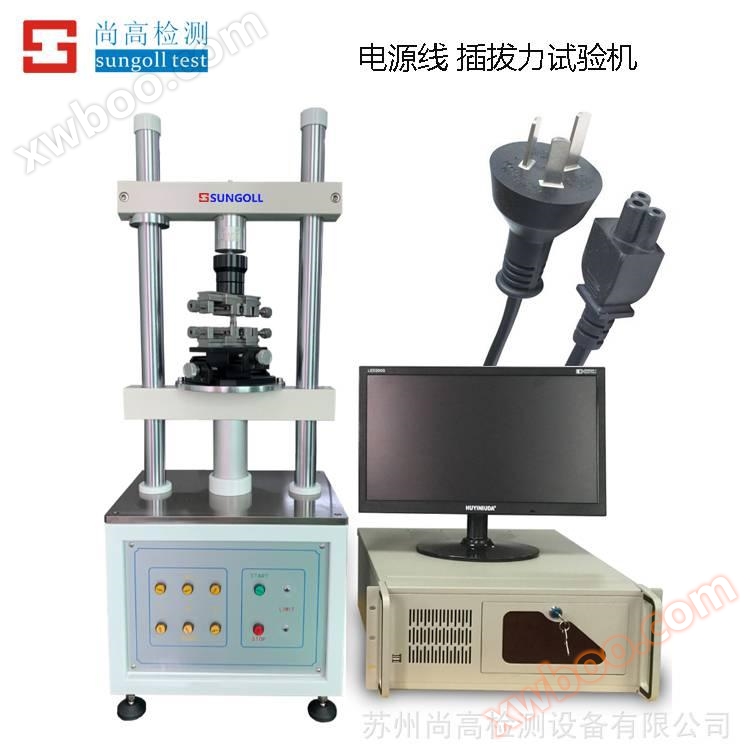
Supply wire swing testing machine, wire bending detection machine, wire bending testing machine, wire winding testing machine
NegotiableUpdate on 03/13
- Model
- Nature of the Manufacturer
- Producers
- Product Category
- Place of Origin
Overview
Shanggao Testing SG-812 Series Wire Swing Testing Machine Wire Bending Testing Machine Wire Bending Testing Machine Wire Bending Testing Machine Product Introduction: Complies with the relevant standards such as UL817 "General Safety Requirements for Flexible Wire Components and Power Cord"
Product Details

Shanggao Testing SG-812 Series
Wire swing testing machine, wire bending detection machine
Wire bending testing machine Wire bending testing machine

Product Introduction:
Comply with the provisions of UL817 and other relevant standards on the general safety requirements for flexible cord components and power cords. Suitable for manufacturers and quality inspection departments to conduct bending tests on power cords and DC cords. It can test the bending strength of plug leads and wires by fixing the test sample to a fixture and applying weight. After bending it to a predetermined number of times, the breakage rate is detected, or the machine automatically stops when it cannot be powered on, and the total number of bending times is checked.
Technical Specifications:
1. Working power supply: AC220V/50Hz;
2. Power: 1000W;
3. Test rate: adjustable from 1 to 60 times per minute;
4. Bending angle: adjustable clockwise 180o and counterclockwise 180o (± 3o); When the bending angle is within 180 degrees, the speed range is 1-60 times/minute, and when the bending angle is between 180-360 degrees, the speed range is 1-45 times/minute;
5. Test station: Conduct 12 lead tests simultaneously each time, with a fixture radius of 45 ° or 25.4mm, and a R90 degree right angle, R12.7 mm,R7.0 mm;
6. Bending times: 0 to 999999 can be preset;
7. Weight of weights: 12 each for 50g, 100g, 200g, 300g, 500g;
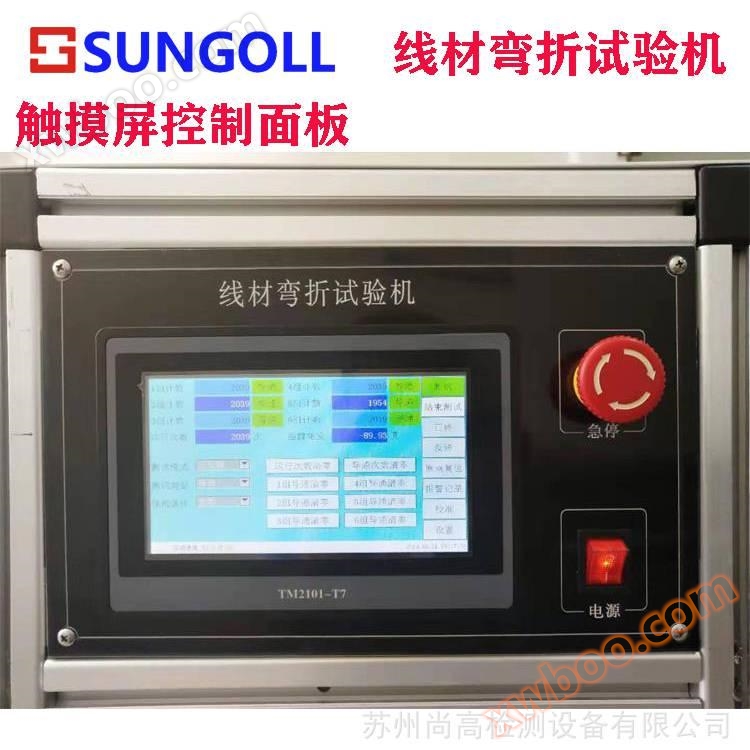
8. Control mode: touch screen control;
9. Weight (approximately): 80kg;
10. Not equipped with instantaneous interruption judgment function;
11. 12 workstations are tested simultaneously, and two groups of 6 workstations are tested separately;
12. The corresponding workstation has corresponding counting, and only when the testing line at the corresponding workstation is completely disconnected, the counting stops. After all 12 lines are completely disconnected, the machine stops.
13. To start the machine, it must be connected to a workstation testing line.
Operation steps:
1. Turn on the power switch;
2. Reset according to the origin and find the origin. Short circuit the two core wires of the tested specimen (if there are multiple core wires, short-circuit them in sequence to form a path), and then clamp them on the test fixture;
3. Thread the test piece through the limit rod and hang the corresponding weight as required. Then connect the two core wire leads of the test piece to the fixture on the corresponding workstation's terminal. Loosen the fastening nut of the limit rod, adjust the height of the limit rod up and down to meet the test requirements, and tighten the tightening nut to fix the limit;
4. After fixing the sample, press "Settings" to access the relevant parameter settings interface;
5. After setting the testing frequency, swing angle, and testing speed, return to the testing interface;
6. Perform point testing, and the machine will automatically stop when the tested cable is completely broken or the set number of times is reached.
Product images


Similar Product Recommend