-
E-mail
jsyesyb@163.com
-
Phone
13813316363
-
Address
271 Jinhu Huancheng West Road, Huai'an City, Jiangsu Province
Product Categories
Jiangsu Yarson Instrument Co., Ltd
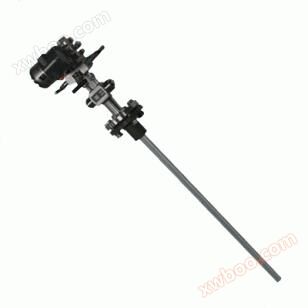
YS-HLV Velbar flowmeter
NegotiableUpdate on 08/20
- Model
- Nature of the Manufacturer
- Producers
- Product Category
- Place of Origin
Overview
Product Introduction: 1. Overview: The YS-HLV Velbar flowmeter adopts an engineering structure design that fully complies with aerodynamic principles. It is a sensing element that achieves unparalleled accuracy, efficiency, and reliability. The Weiliba uniform velocity flowmeter utilizes the principle of differential pressure ..
Product Details
1、 Overview:
YS-HLVverabarAdopting an engineering structural design that fully complies with aerodynamic principles, it is a sensing element that achieves unparalleled precision, efficiency, and reliability. The Weiliba uniform velocity flowmeter uses the principle of differential pressure for flow measurement, and follows the flow continuity equation and Bernoulli equation. It is currently internationally recognized as a new type of plug-in flow meter with high accuracy, good repeatability, and reliable operation in flow primary source detection.
The Weiliba flowmeter has a simple structure, easy disassembly and assembly, low pressure loss, and low usage and maintenance costs. In today's world where energy is increasingly scarce due to rapid economic development, the Weiliba flowmeter is an energy-saving flowmeter that is worth promoting and using. Especially in pipelines with a diameter greater than 200 millimeters, the advantages of the Weiliba flowmeter are more obvious. Therefore, in industries such as power, metallurgy, and petrochemicals, the Velbar flowmeter is often used as a ***** instrument.
2、 Working principle and flow calculation formula
When fluid flows through the probe, a high-pressure distribution area is generated in its front, and the pressure in the high-pressure distribution area is slightly higher than the static pressure of the pipeline. According to the Bernoulli equation principle, the velocity of the fluid increases as it flows through the probe, creating a low-pressure distribution area at the back of the probe. The pressure in the low-pressure distribution area is slightly lower than the static pressure of the pipeline. After the fluid flows through the probe, a partial vacuum is generated at the back of the probe, and vortices appear on both sides of the probe. The cross-sectional shape, surface roughness, and location of the low-pressure tapping hole of the Weiliba flowmeter probe are key factors determining the performance of the probe. The stability and accuracy of low-voltage signals play a decisive role in the accuracy and performance of the uniform velocity probe. The Weiliba flowmeter probe can accurately detect the average differential pressure generated by the average velocity of the fluid. The Weiliba flowmeter probe has multiple pairs of pressure tapping holes arranged according to certain criteria in the high and low pressure areas, making it possible to accurately measure the average flow velocity.
The Weiliba flowmeter system mainly consists of three parts: (see figure)
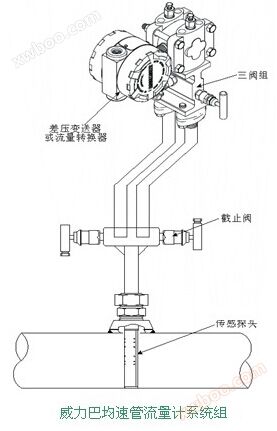
(1) Primary source part: Powerbar sensing probe.
(2) Differential pressure conversion section: Differential pressure transmitter or flow converter.
(3) Flow display cumulative part: secondary instrument of flow integrator or PLC/DCS system.
Main technical indicators of Weiliba flowmeter
Applicable pressure: 0-40MPa
Applicable temperature: -180 to+550 ° C
Measurement accuracy: ± 1%
● Repeatability: ± 0.1%
Sensor material: 304, 316L or specially customized
Pipeline size: DN38~DN15000 round or square pipe
Range ratio: 10:1
● Flow range: Measurement upper and lower limits are within the probe strength and allowable small differential pressure
The required small flow rate and differential pressure for measuring the Velbar flowmeter
The main application areas of Weiliba flowmeter
The Weiliba flowmeter is suitable for measuring various media: full tube, unidirectional flow, single-phase gases, vapors, and liquids with viscosity not exceeding 10 centipoise, such as:
(1) Measurement of primary and secondary air in power plants
(2) Measurement of blast furnace gas in steel mills
(3) Compressed air measurement
(4) Measurement of gas, nitrogen, oxygen, etc
(5) Measurement of ethane, ethylene, natural gas, etc
(6) Measurement of saturated steam, high and low pressure steam
(7) Measurement of tap water, circulating water, etc
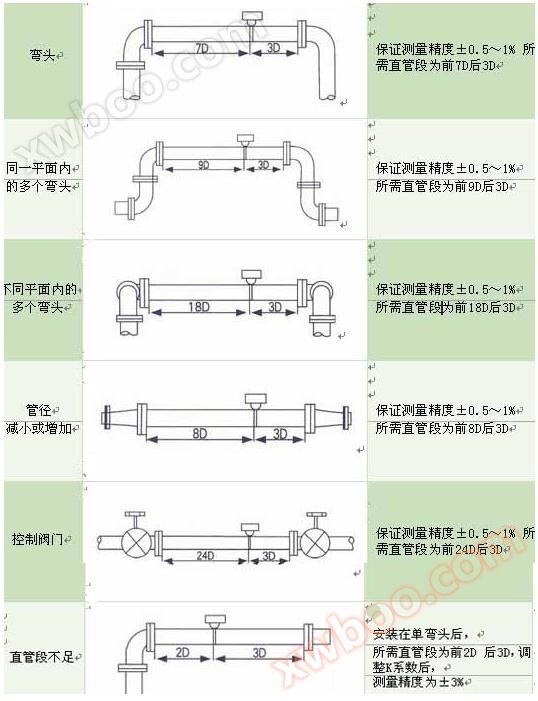
Requirements of Weiliba flowmeter for straight pipe section
The Weiliba flowmeter reduces the requirements for straight pipe sections due to the pressure equalization effect of multiple detection holes. The length of the straight pipe section before and after the orifice plate flowmeter is required to be at least 30 times the diameter, while the length requirement for the straight pipe section of the Velbar flowmeter is relatively lower than that of the orifice plate, generally about 10 to 25 times the diameter.
Similar Product Recommend