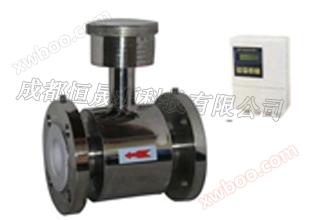
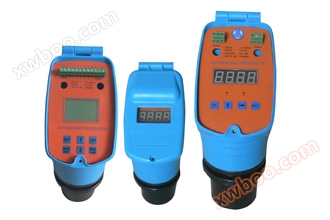
-
E-mail
cdysyb@163.com,@qq.com
-
Phone
18908016281,13980818230
-
Address
No. 1001, Zone A, No. 1299 Tianfu Avenue South, High tech Zone, Chengdu City
Product Categories
Chengdu Hengshengyuan Technology Co., Ltd

DHTN-100F fixed ultrasonic flowmeter
NegotiableUpdate on 09/22
- Model
- Nature of the Manufacturer
- Producers
- Product Category
- Place of Origin
Overview
The DHTN-100F fixed ultrasonic flowmeter uses the latest and most advanced integrated circuits and microprocessors produced by internationally renowned semiconductor component manufacturers. A new universal time difference multifunctional ultrasonic flowmeter designed using low-voltage multi pulse balanced transmission and reception patented technology is suitable for continuous measurement of flow and heat of most clean and uniform liquids without high concentration suspended particles or gases in industrial environments.
Product Details
High measurement accuracy: linearity better than 0.5%; The repeatability accuracy is better than 0.2%; The measurement range is large. Isolated RS485 dual interface, with a transmission distance of over kilometers. Ultrasonic sensors can be installed in various ways. It has the function of determining the type of fluid based on the sound velocity of the fluid. Adopting patented technology of low voltage, multi pulse, and balanced transmission and reception. Strong anti-interference ability, powerful memory function, parameter settings are not lost in case of power failure.
Measurement range: DN15-6000mm. Measurement accuracy: better than 1%. Repeatability: better than 0.2%. Measurement cycle: 500ms (2 times per second, 128 sets of data collected per cycle). Display: 2 * 10 Chinese character backlit LCD can display instantaneous flow and positive, negative, and net cumulative amounts. Operation: 4 * 4 touch the keyboard. Signal input: 3-channel 4-20mA analog input, capable of inputting temperature, liquid level, and pressure. Signal output: 4-20 mA or 0-20 mA; impedance 0-1k, accuracy 0.1%. One isolated RS485 output. One isolated OCT channel. 1 relay output. Working power supply: 220V or 85-264VAC or isolated 24VDC. Transmission distance: 20 meters to 500 meters. Pipe materials: steel, stainless steel, cast iron PVC、 All dense pipes such as copper, aluminum, and cement pipes are allowed to have lining. Temperature: Host: -30 ℃~80 ℃. Flow sensor: -40 ℃~160 ℃. Humidity: Host: 85% RH. Flow sensor: capable of working in water, with a depth of 3 meters. Communication protocols: MODBUS protocol, M-BUS protocol. Turbidity: 10000 ppm, with low bubble content. Flow direction: bidirectional measurement in both directions, and can measure net flow or heat. Maximum flow velocity: 64m/s (flow velocity resolution 0.001 m/s). Protection level: Sensor IP68; Host IP65.
Model: S1H Small Measurement range: DN15~100mm Size: 45 * 30 * 30mm Model: Plug in type A (direct insertion type) Insert Type B (for cement pipes only) Insert C-type (oblique insertion type) This sensor solves the problem of external sensors being used for testing It is difficult to receive signals when measuring pipelines with thick scaling The problem of signal attenuation during long-term measurement, Equipped with non-stop installation, maintenance free, and compatible with pipe diameter Characteristics such as irrelevant and no pressure loss External mounted sensors are directly attached to the outer surface of the measured pipeline to achieve flow measurement One installation method that solves the flow of other principles The difficulty of cutting off pipes and stopping production during installation, This is the basic installation method of ultrasonic flowmeter, It is independent of pipe diameter, easy to install, and does not require Features such as shutdown and no pressure loss.
Attachment diagram
Model and Description
Remarks
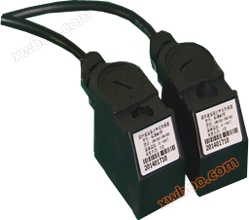
High temperature small sensor

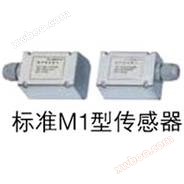
Model: Standard M1 type
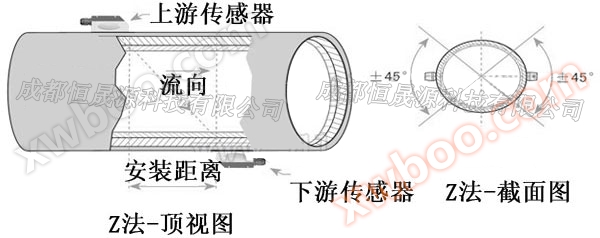
1、 Installation instructions The installation of DHTN-100F series ultrasonic flowmeter is the simplest and most convenient among all flowmeters. Simply select a suitable measurement point, input the pipeline parameters at the measurement point into the flowmeter, and then fix the sensor on the pipeline. Example diagram of sensor installation points: 2、 Common installation methods: V method, Z method, N method, and W method (see installation diagram for details) In general, when installing pipes with diameters ranging from DN15-200mm, the V method can be preferred. When the V method cannot measure the signal or the signal quality is poor, the Z method can be used. When installing pipes with diameters above DN200mm or measuring cast iron pipes, the Z method should be preferred. The N method and W method are less commonly used methods and are suitable for the installation of fine pipelines with a diameter of DN50mm or less. The following are installation diagrams for Z-method and V-method 3、 Installation distance of sensors:The installation spacing of external clamp sensors is based on the distance between the innermost edges of the two sensors (see installation diagram). The calculation method for spacing is to first enter the required parameters in the menu, view the number displayed in window M25, and install the sensors according to this data. 4、 Attention: 1. During installation, the pipeline area where the sensor is to be installed must be cleaned thoroughly to expose the original luster of the metal.
The temperature and pressure at the installation point should be within the working range of the sensor.
2. Fully consider the scaling condition on the inner wall of the pipe: try to choose pipes without scaling for installation. If this cannot be met, scaling can be considered as lining for better measurement accuracy
3. Two sensors must be installed in the horizontal direction of the pipeline axis and at a horizontal position along the axis; Install within a 45 degree range to prevent the sensor from being affected by incomplete pipes, bubbles, or sedimentation in the upper part, which may affect its normal measurement. If the installation location is limited by space and cannot be installed horizontally symmetrically, sensors can be installed vertically or at an angle while ensuring that there are no bubbles in the upper part of the pipe.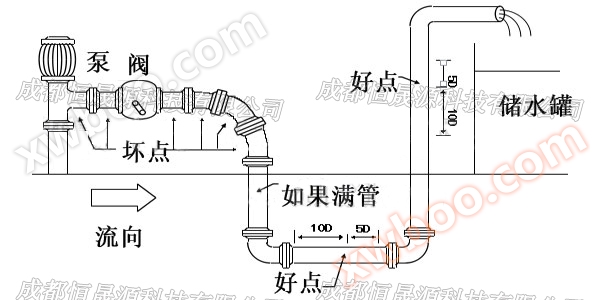

2. The shielding wire of the ultrasonic signal cable can be suspended without connection, and should not be short circuited with the positive and negative poles (red and blue wires).
After the sensor is connected, it must be filled with sealant (coupling agent) to prevent water from entering.
After filling the sensor with sealant and covering it, the sensor shielding wire must be pulled into the wire hole and tightened to prevent water from entering.
5. When bundling sensors, the fixture (stainless steel strip) should be fixed at the center of the sensor to ensure even force distribution and prevent sliding.
6. The contact area between the sensor and the pipeline should be coated with sufficient coupling agent to prevent air, dust, or rust from entering and affecting the transmission of ultrasonic signals.