-
E-mail
service@h3c.com
- Phone
-
Address
H3C Company, 466 Changhe Road, Binjiang District, Hangzhou City
Product Categories
New H3C Technology Co., Ltd

H3C Fusion Integration Platform
NegotiableUpdate on 12/28
- Model
- Nature of the Manufacturer
- Producers
- Product Category
- Place of Origin
Overview
As the world enters the era of rapid growth in the digital economy, enterprises urgently need to build a new generation of digital platforms to accelerate their digital transformation. Digital transformation requires agile, scalable, elastic, and highly available data architectures and flexible applications. Building modern agile integration and efficient real-time data management, insight, and decision-making systems for all scenarios in complex hybrid architectures is the key to digital platforms, enabling them to cope with complex multi cloud environments and improve application development efficiency at low cost. Digital transformation will help enterprises shape three major capabilities in three dimensions - digital connectivity, digital insight, and digital innovation. Building digital connectivity is the foundation of digital transformation. Based on the information technology capabilities that cover the entire value chain of the business, in the early stages of digital transformation, enterprises should focus on shaping their own digital connectivity capabilities. This requires enterprises to connect the previously independent "chimney style" systems, build a unified big data resource pool, and based on this, create an interconnected platform for "people, devices, systems, and businesses", and establish a complete digital application system. In the process of enterprise digital transformation, there will be many challenges, such as the lack of a unified way to integrate equipment information; Diversified data formats make it difficult to transmit and integrate; How to quickly respond to business needs in the long online cycle of enterprise applications; Lack of convenient ways to share data and backend services with partners; Different business systems store and manage different data, with a single access mode. Any cross system data aggregation and statistics become difficult and complex, while also bringing huge load pressure to the system. Faced with these issues, there is an urgent need for an integrated service product that can provide fast and simple messaging, data, services, and settings .....
Product Details
system architecture
The New H3C Oasis Platform is a digital base platform that aims to break through the concept of "information silos" and eliminate "data chimneys", helping organizations use data to maximize its value.
The Oasis Fusion Integration Platform provides APIs, messages, and data integration for various business systems, shields underlying system differences from business applications, provides unified service support, helps developers quickly develop the ability to integrate existing systems, and performs system integration to meet the rich connectivity needs of the digital process as an elastic distributed iPaaS platform.
The Oasis Integration Platform includes capabilities such as message integration, service integration, data integration, and resource management. By connecting with the data operation platform, it provides standard data models and forms various business data models. By leveraging asset development, templates are formed for commonly used APIs to achieve reuse and accelerate the provision of external services. In addition, scripting commonly used data, encapsulating general capabilities, reusing implementation capabilities, and avoiding duplicate development. Open to the outside world, provide standardized interfaces and service models, such as facial recognition, speech synthesis, etc. as standard capability outputs, without the need for users to configure and operate on the fusion integration platform. Standardize the service model to achieve rapid reuse and external development of the service model.

Main product features
Massive heterogeneous data integration
The complexity and diversity of enterprise business systems bring about a diversity of data types, such as traditional relational database data, messages API、 The completeness of data integration functionality is challenged by files and other factors. On the other hand, with the development of business, the amount of data has also shown explosive growth, posing high challenges to the efficiency of data integration. Oasis Integration Platform, supporting over 30 types of data sources, providing data, messages API、 Multiple integration capabilities such as IoT protocols, including data integration for batch processing and real-time scenarios, and efficient and secure integration services for applications, enable an integrated platform to integrate massive heterogeneous data.
Event driven distributed message queue
IoT devices capture events and generate event messages, which are transmitted in real-time through a unified distributed message queue provided by a fusion integration platform. The intelligent processing end system of the event obtains the corresponding event messages for consumption through event queries and subscriptions. The processed events or flow formed case type messages are integrated and transmitted in real-time through the fusion integration platform. Reporting and distribution use different data channels to drive IoT devices to perform corresponding actions, such as opening and closing gates and intelligent lighting devices. The flow driven process of events uses a unified message access mechanism and standardized message channels to reduce system integration costs caused by the use of different message components.
Safe and efficient event flow center
The Oasis Fusion Integration Platform provides a persistent, high-throughput quasi real time message pipeline system that is compatible with native Kafka message processing features and supports secure message transmission. The publication/subscription of messages is strengthened through SASL authentication, SSL encryption, and security groups to enhance network access control. It provides efficient event access channels for event storage, event querying, event subscription, event publishing, event monitoring, and other event generation and consumption processing ends. It provides high-throughput message processing services with latency reduced to milliseconds, supporting efficient flow of event streams.
Optimize the certification system and maintain consistency with the certification methods provided by the integrated platform to enhance product usability. When the integration platform cluster expands and shrinks, the leader, Replicas, and Isr data of events can be reallocated with just one click on the web interface. For new or existing tasks, one click tuning can be done through the web interface without the need for tedious command-line code. You can view the basic information of the event and the progress of each consumer's consumption of the event with just one click on the web interface, and have a comprehensive overview of the event.
One stop API development
The system provides one-stop API integration and development capabilities, quickly opens databases as Restful interfaces, quickly connects to partner application system APIs for unified authentication and authorization, and supports API custom development and orchestration. Provide zero coding API generation capability for database types such as Oracle, SQLServer, MySQL, PostgreSQL, Dameng, Vertica5, etc., without the need to manually write SQL, API development can be completed in the wizard trial process. The selection of input parameters and output fields during the process can be automatically generated without the need for manual configuration. The association conditions and complex SQL query statements also support manual configuration, and the configuration process follows the wizard to meet the easy-to-use and concise characteristics of API development. The diversity of authentication methods for third-party interfaces brings great workload to the use of APIs and data connections between applications. By integrating platform authentication templates and proxy forwarding of interfaces, third-party interface capabilities are provided for unified access and management. Through the unified authentication and opening of the integration platform, upper layer applications only need to access the unified authentication method of the integration platform to complete the original complex docking work, greatly reducing the workload and usability of docking. Function API can achieve API orchestration in complex scenarios by writing JavaScript scripts. Existing APIs can be flexibly orchestrated into new API capabilities through function APIs, which can shield the differences in API on the access side and achieve unified encapsulation and openness of APIs to meet the API requirements in the scenario.
API governance throughout the entire lifecycle
Provide three types of API registration to meet the diversity of API registration endpoints, test access to developed APIs to check if they are functioning properly, and repair any abnormal APIs accordingly. Test the normal interface through the deployed API gateway to complete the preparation for opening the API to the outside world. The API gateway supports cross network API openness, helping enterprises quickly achieve cross network collaboration. The authorization function grants and revokes access permissions to APIs, and deletes APIs at the end of their lifecycle. From the perspective of product functionality, we provide API management throughout the entire lifecycle, including registration, testing, deployment, authorization, editing, and deletion. From the perspective of business processes, the integration platform provides API access and generation capabilities for the database at the application system layer, visual service orchestration capabilities at the business process layer, secure authorization, application, subscription, and approval control capabilities at the consumer experience layer, and full lifecycle API management, monitoring, and governance capabilities.
Global Business Asset Management
Provides integrated management of data assets, business interfaces, and event messages. Register, test, and deploy business assets, provide import and export functions for integrated assets, and support exporting registered assets to and from files. Business assets are authorized to the application workspace through application, approval, and certification, completing the empowerment of the application.
Product functional characteristics
data integration
1. Graphical user interface
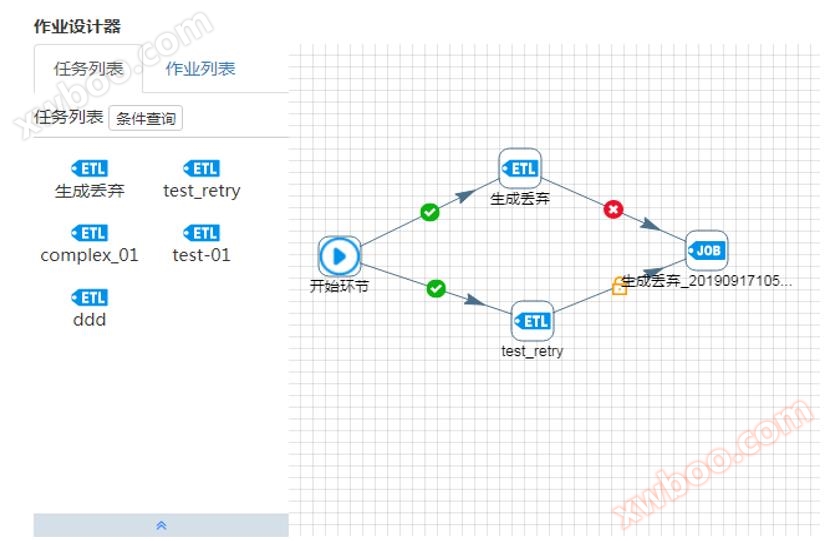
Data integration provides full process orchestration visualization operations, compatible with multiple devices and browsers based on BS architecture, and offers SWT based data extraction, processing, and loading tools. Developers can easily configure complex tasks through drag and drop in a graphical interface without any coding, and business personnel can easily control data flow. The system provides over 70 data processing components to handle various data processing responsibilities, reducing the difficulty and threshold of data integration.
2. Massive data sources
Configure commonly used resources such as database connections, ETL processes, and configuration items related to big data clusters once and use them multiple times in multiple locations. The supported data sources are as follows:
Support reading, parsing and integrating semi-structured files such as Excel, CSV, XML, JSON, etc;
Support universal relational database interfaces, such as DB2, SAP HANA, Oracle, SQLServer, MySQL, PostgreSQL, MongoDB, Redis, Dameng and other databases;
Support MPP database interfaces such as Teradata, Greenplum, Vertica, H3C DataEngine MPP, etc;
Support Hadoop and adapt to data types such as HDFS, Hive, HBase, Kafka, ElasticSearch, etc;
Support extraction of FTP and SFTP file data;
Support WebService, Restful, MQTT;
Support JDBC and ODBC database connection standard APIs, etc.
3. Strengthen data processing
Support batch (offline) synchronization, real-time synchronization, incremental synchronization, and full library migration capabilities. A data processing model based on distributed data streams, maximizing the processing capabilities of each step; Simultaneously supporting parallel execution of multiple instances. Provide a collection of over seventy data processing and transformation components, supporting diverse performance processing of data and simplifying manual operations in large-scale data integration.

4. Unified scheduling of homework
Job scheduling supports multi time dimension (day, hour, minute) task scheduled scheduling, which only requires a few simple steps to complete data incremental extraction. It is easy to configure, flexible, and user-friendly, and supports flexible and multi angle model job scheduling mechanisms, including real-time scheduling, scheduled scheduling, time interval loop scheduling, etc. Through system integration and optimization, it ultimately achieves unified automated scheduling management for All in One.
5. Comprehensive operation monitoring
The system provides visual multi-dimensional job operation monitoring, maximizing the promotion of excellent usability. It provides resource monitoring for multiple actuators in the operating environment, including CPU usage, memory usage, disk space, etc. Through unified monitoring, task scheduling can be reasonably allocated to improve data processing efficiency. At the same time, in scenarios such as task errors or excessive actuator load, data integration supports informing users of real-time alarm information through pre-defined methods.
6. Abnormal tolerance mechanism
The abnormal termination of both the server and client does not affect the normal operation of non abnormal parts. For example, after the server terminates abnormally, the executor, as a job (task chain) execution container, will continue to execute the issued job and provide feedback on the execution result and other information to the server after the service starts.
Message integration
1. A secure and reliable message transmission mechanism
Compatible with native Kafka features, it has all the message processing characteristics of native Kafka, supports secure message transmission, strengthens network access control through Sasl authentication, message storage encryption and other measures, supports high reliability of message data, supports message persistence, and multi replica storage mechanism.
2. High performance quasi real time message processing
As an intermediate link in data storage, message integration provides high-throughput message processing services with latency reduced to the millisecond millisecond level. The native Kafka client does not provide a mechanism to view the content of Topic messages. The message set provides users with a web page that can view the message body of all partitions in all Topics at any offset in real time. Message query mainly provides millisecond level, visual message query capabilities in Kafka clusters, supporting filtering by partition and production time.
3. Consumption progress
For topics with large data volumes, users can view the real-time consumption progress of all specific partitions of topics consumed by the consumer group through the web page provided by message integration.
4. Topic reassignment
When the resource usage of Kafka cluster exceeds the system configuration, it is necessary to expand Kafka nodes to achieve resource expansion of Kafka cluster. The newly added Kafka nodes will only participate in the work when creating new topics, and will not automatically balance the partitions on other broker nodes before, which cannot achieve the load effect. After the Kafka cluster is expanded, in order to alleviate the load pressure on the original Broker nodes, all partitions of topics are reallocated to all expanded nodes through the Topic reallocation function of message integration to achieve load balancing. Message integration can automatically generate reassignment suggestions and also support users to manually adjust them.
5. Comprehensive monitoring of message indicators
Message integration provides various monitoring metrics for Kafka clusters, including Topic backlog, number of messages, message capacity, number of failed production/consumption requests, number of rejected bytes, number of message conversions, number of production/consumption requests, etc.
service integration
1. Zero encoding generation API
The platform provides guided API registration and publishing, zero code generation services, easy and fast operation, and strong usability.
2. Cross network interface release
The API gateway provided by the platform can access interfaces from different networks, support cross network and cross system API openness, and help enterprises quickly achieve multi network collaboration.
3. Service orchestration
The already connected APIs are arranged in a tora drag series parallel relationship through canvas, providing filtering and merging components to solve specific business scenarios.
Arrangement process processing: supports dependency processing of the execution order of multiple APIs, including sequential and parallel relationships
Parameter parsing for orchestration: parsing the return results of multiple APIs to enable the return results of the previous API to be used as input for the subsequent API or as output for the entire orchestrated API
Choreography process control: Determine the subsequent execution process branch based on the return result of a certain API (which can handle types including: numerical, string, date, array).
Combining the results of two APIs (List type) based on the values of two specific fields
Arrangement result selection: Select the return value of the arranged API from certain APIs, and choose from API components or merged components

4. Southbound certification
The platform supports the integration of third-party interfaces with dynamic authentication, which can quickly solve authentication problems through interface configuration. When users access APIs, they only need to authenticate through the platform's API gateway, without being aware of the authentication of third-party interfaces.
5. Containerized operation and maintenance management
The platform adopts containerized cluster deployment, flexible container orchestration, automated construction and deployment, which improves development and operation efficiency and resource utilization. It provides diversified and comprehensive services such as elastic scaling, resource isolation, disaster recovery, load balancing, etc., helping enterprises build high availability and secure controllable mechanisms for services in complex business scenarios.
runtime environment
attribute |
Minimum Requirements |
Recommended Configuration |
number of machines |
3 |
≥ 3 (supports expansion) |
CPU |
2 channels x 10 cores |
2 channels x 12 cores |
memory |
256GB |
512GB and above |
system disk |
600GB SAS disk, 2 RAID1 disks |
600GB SSD drive, 2 RAID1 disks |
data disk |
7.2krpm SATA disk, 1TB or more, 4 pieces |
10krpm SAS disk or above, 1.2TB or above, 4 pieces |
network card |
Gigabit Ethernet |
10 Gigabit Ethernet card |


