-
E-mail
wxbrck@ 163.com
-
Phone
13812024099
-
Address
No. 35 Xigang East Road, Xishan District, Wuxi City
Product Categories
Jiangsu Borui Measurement and Control Technology Co., Ltd
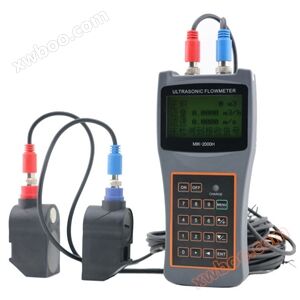
Platinum Rui Ultrasonic Flow Meter - Wuxi Platinum Rui Measurement and Control
NegotiableUpdate on 09/10
- Model
- Nature of the Manufacturer
- Producers
- Product Category
- Place of Origin
Overview
1、 Working principle: Handheld ultrasonic flowmeter is convenient, fast, and mobile for measuring flow rate. It is a must-have product for sewage environmental monitoring departments and large caliber tap water flow measurement. This product features a wide measurement range and can use different types of sensors to achieve aperture ..
Product Details
1、 Working principle
Handheld ultrasonic flowmeter is convenient and fast to use, and can be moved to measure flow. It is a must-have product for sewage environmental monitoring departments and large caliber tap water flow measurementThe product features a wide measurement range and the use of different types of sensors, which can measure the flow rate of pipes with diameters ranging from DN20 to DN6000. High precision measurement, with measurement accuracy better than ± 1%, linearity of 0.5%, and repeatability accuracy of 0.2%. Non contact measurement involves attaching a magnetic ultrasonic flowmeter sensor to the outer wall of the pipeline to complete flow measurement. Built in data logger, with a space of 24K bytes, can store 2000 rows of measurement data. The charging power supply is equipped with a large capacity nickel hydrogen rechargeable battery, which can support continuous operation of the flowmeter for more than 12 hours. The large screen LCD display can simultaneously display accumulated flow, instantaneous flow, flow rate, working status, etc. as shown in Figure 1.
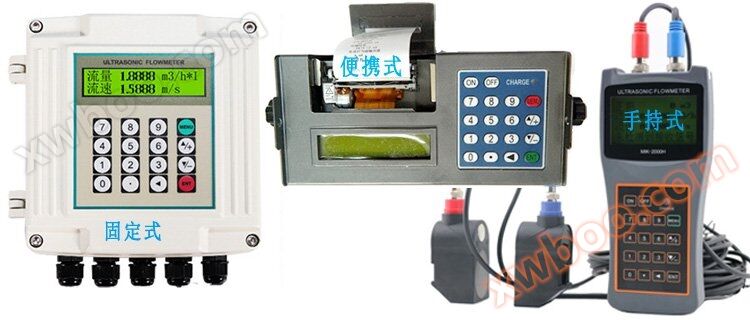
Figure 1
2、 Product Features
1. Good stability and high accuracy
Linearity better than 0.5%, repeatability accuracy better than 0.2%, measurement accuracy better than ± 1%
2. Built in nickel hydrogen rechargeable battery
Equipped with a large capacity nickel hydrogen rechargeable battery, it can support continuous operation of the flowmeter for more than 12 hours
3. Large screen LCD display
It can simultaneously display cumulative flow, instantaneous flow, flow rate, working status, etc.
4. Compact size, easy to carry
Volume: 210 × 90 × 30mm, weight is only 0.5kg (main unit)
5. Non contact measurement
By attaching and fixing the magnetic ultrasonic flowmeter sensor to the outer wall of the pipeline, flow measurement can be completed
6. Support Chinese and English menus
Different versions of flow meters can support Chinese or English menus
7. High reliability
By adopting low-voltage and multi pulse transmission circuits, the measurement accuracy, service life, and reliability are greatly improved
8. Strong anti-interference ability
Adopting a dual balanced signal differential transmission and reception circuit, effectively resisting strong interference sources such as frequency converters, TV towers, and high-voltage lines
9. Built in data logger
Built in data logger with a space of 24k bytes, capable of storing 2000 rows of measurement data.
10. Wide measurement range, three probe options available
By selecting different types of sensors, it is possible to measure the flow rate of pipelines with diameters ranging from DN20 to DN6000mm, with a measurement flow rate range of -32m/s+32m/s
3、 Model parameters
| Handheld ultrasonic flowmeter | Pipe section ultrasonic flowmeter | External ultrasonic flowmeter | |||||||
| Pipe diameter range (mm) | DN80-4000 | DN20-2000 | DN20-4000 | ||||||
| Flow velocity range (m/s) | 0.01~12 | ||||||||
| Accuracy (%) | mono | dual-channel | Three channels | mono | dual-channel | Three channels | 1.5 | ||
| 1 | 1 | 0.5 | 1.0 (Correction 0.5) | 0.5 | 0.5 | ||||
| measuring medium | Drinking water, river water, seawater, groundwater, cooling water, high-temperature water, sewage, lubricating oil, diesel, fuel oil, chemical liquids, other homogeneous fluids | ||||||||
| Pipe material | Metal (such as carbon steel, cast iron, stainless steel, aluminum, etc.) Non metallic materials (such as PVC, organic glass, etc.) | ||||||||
| Pipe lining material | Fiberglass reinforced plastic, mortar, rubber, etc | ||||||||
| signal output |
1. 4-20mA: Impedance less than 800 Ω, photoelectric isolation, accuracy of 0.1%. 2. Accumulated pulse output: photoelectric isolation, passive open circuit output, transmission distance less than 500m. 3. RS-485: Optoelectronic isolation, selectable baud rate, transmission distance greater than 1.6Km 4. Printer: RS-232 serial port mode. The printer is an optional accessory. 5 M-BUS. |
||||||||
| Keyboard | 2 × 8 Chinese character keyboard | ||||||||
| monitor | 2 × 10 Chinese character display or English display | ||||||||
| Measurement function | Display instantaneous flow rate, instantaneous flow rate, positive cumulative flow rate, negative cumulative flow rate, net cumulative flow rate, cumulative operating time, instantaneous heat supply, cumulative total heat, power outage time, etc. | ||||||||
| data store | It can store measurement data for the first 720 hours, the first 365 days, the first 36 months, and the first decade, including instantaneous flow, cumulative flow, power outage time, etc. | ||||||||
| ambient temperature | Converter: -10~45 ℃ (please specify for special environments) | ||||||||
| Sensor: -40~+60 ℃ (normal temperature type) | |||||||||
| -40~+160 ℃ (high temperature type) | |||||||||
| Sensor material | Stainless steel and ceramics | Stainless steel and ordinary carbon steel | The normal temperature type is nylon, and the high temperature type is alloy aluminum | ||||||
| Sensor pressure bearing capacity | The pressure inside the pipe is less than 4.5MPa | DN20-700mm, less than 2.5MPa | It is recommended not to work in water immersion, which is not related to the pressure inside the pipeline | ||||||
| DN800-2000mm, less than 1.6MPa | |||||||||
| Sensor protection level | IP68 | ||||||||
| Converter protection level | Wall mounted converter: IP65 Disk mounted converter: IP52 Integrated converter: IP67 | ||||||||
| Explosion-proof rating | EXdⅡBT6 | ||||||||
| Sensor cable length | < 500m | < 500m | < 300m | ||||||
| Sensor cable model | Special cable SEYV-75-2 (diameter 7mm), the shorter the better to reduce interference, and it can also be extended to 300m. If it is longer, the cable should be thicker | ||||||||
| working power supply | AC220V, DC12-36V 0.8A (optional) | ||||||||
| Converter dimensions | Wall mounted: 213 × 185 × 107mm Panel mounted: 160 × 80 × 250mm Integrated: 185 × 140 × 100mm | ||||||||
| Sensor external dimensions | 220 × ø 20 (stem) × ø 50 (connection) mm | Refer to the sensor data sheet for the pipeline section | 60×40×35mm | ||||||
| Converter weight | Wall mounted: 1.2K g Pan mounted: 0.8kg Integrated: 1.4kg | ||||||||
| Sensor weight | 0.7Kg per piece | Refer to the sensor data sheet for the pipeline section | 0.2Kg per tube | ||||||
| Thermal measurement function | Measure heat supply, heat loss, inlet temperature, and outlet temperature | ||||||||
4、 Installation Guide
Due to the significant impact of pipeline conditions on measurement accuracy, the installation location of the detector should be chosen in a place that meets the following conditions
1. It is necessary to ensure that the straight pipe section where the probe is installed is 10D on the upstream side (D is the pipe diameter) and 5D or more on the downstream side. At the same time, there should be no factors that disturb the fluid (such as pumps, valves, throttling components, etc.) within 30D on the upstream side, and try to avoid uneven and welded positions in the measured pipeline.
2. The pipeline should be filled with liquid, and the fluid should not contain bubbles or other foreign objects. For horizontal pipelines, install detectors within ± 45 ° of the horizontal centerline. Try to choose the horizontal centerline position as much as possible.
3. Treatment of detector installation surface.When installing the detector, if there is a covering on the pipe section, it should be peeled off first. If there is asphalt, rust, or uneven corrosion, it should be polished with sandpaper or flat file (petrochemical companies should try to avoid using grinding wheels for polishing operations to avoid sparks),Its width is the circumference surface with a detector installation size of (L)+200mm.
4. After determining the distance between the two probes and the basic position of the straight pipe section as required, one of the probe positions should be determined on both sides of the horizontal (or vertical) pipeline within a horizontal ± 45 ° angle, and local polishing should be carried out to ensure that there is no rust or pitting on the circumferential surface of approximately (L)+200mm. Use a tape measure to tightly wrap around the outer circumference of the pipeline, calculate the outer diameter of the pipeline, and use a thickness gauge to measure the thickness of the pipeline wall.
5. After determining the installation position, apply coupling agent to the probe and fix one side of the probe. The probe on the other side is tightly attached to the pipe wall, and then the probe is carefully adjusted to observe parameters such as signal strength and find the best measurement point. After adjusting the signal of the ultrasonic flowmeter, use the provided fixture to fix the probe. Be careful not to tilt the steel wire rope to avoid pulling the ultrasonic flowmeter probe and causing it to shift. Then use silicone to seal the probe around the pipeline as shown in Figure 2. Before the glue dries, it is necessary to pay attention to the waterproofing of the probe (the outer shielding wire of the signal wire must be reliably grounded), and finally check the installation distance and signal related parameters again to ensure accuracy.
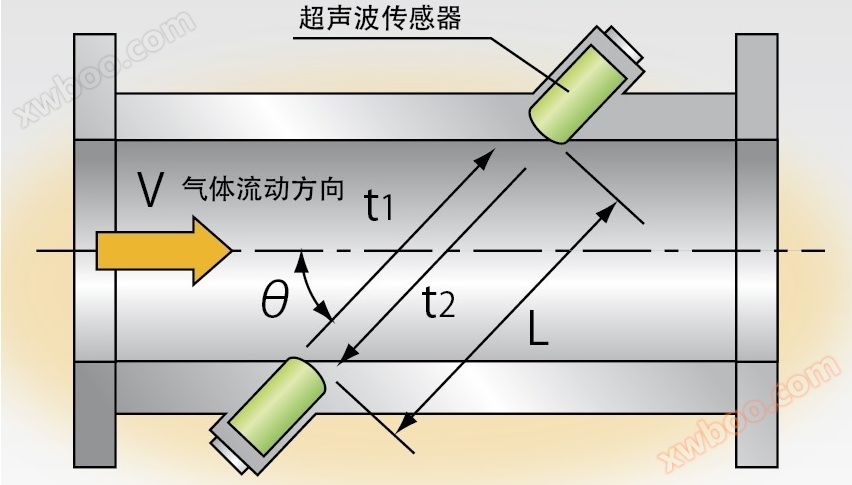
Figure 2
5、 Product price
The price of ultrasonic flow meters is a focus of attention for major manufacturers, and the price of different models of ultrasonic flow meters varies,The more functions there are, the more expensive the price becomes. For example, the price with printing function is slightly higher, but the final price still depends on the actual working conditions on site. Platinum Rui will serve you with the most favorable price and quality!
Similar Product Recommend