-
E-mail
atlasinfo@atlasinfo.com.cn
- Phone
-
Address
Room 701, Guanhui Building, Building 3, No. 30 Shixing Street, Shijingshan District, Beijing
Product Categories
Beijing Atlas Information Technology Co., Ltd

Time Space Big Data Platform
NegotiableUpdate on 09/19
- Model
- Nature of the Manufacturer
- Producers
- Product Category
- Place of Origin
Overview
1、 Platform Overview: The platform is characterized by time-series databases and distributed data technology, using parallel computing, memory computing, multi-level caching, dynamic scheduling, and other technologies to achieve parallel transformation of spatiotemporal big data management and analysis algorithms, meeting the needs of rapid cloud publishing, browsing, querying, and analysis of large-scale spatiotemporal data in cloud environments
Product Details
1、 Platform Overview
This platform is characterized by time-series databases and distributed data technology, using parallel computing, memory computing, multi-level caching, dynamic scheduling, and other technologies to achieve parallel transformation of spatiotemporal big data management and analysis algorithms, meeting the fast publishing, browsing, querying, and analysis needs of ultra large scale spatiotemporal data in cloud environments.
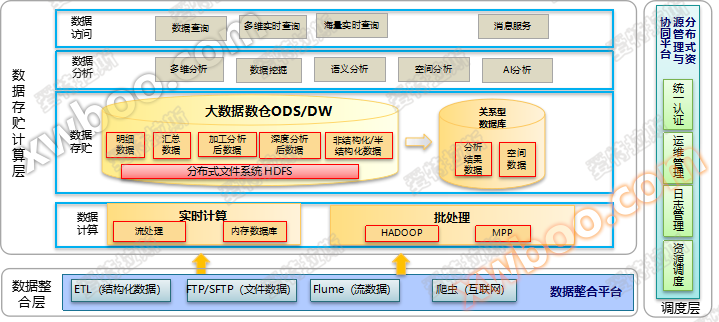

2、 Platform features
This includes a large amount of spatial data produced according to surveying and mapping geographic information standards, such as DLG, DOM, DEM, DRG, as well as larger amounts of spontaneous data, such as text, images, voice, videos, etc., both in physical space and virtual space. As the most important big data, spatiotemporal big data not only has the general characteristics of big data, but also has its own particularities. The platform mainly has the following characteristics:
1. Spatiotemporal big data includes the correlation between objects, processes, and events in terms of space, time, semantics, and other aspects.
2. Spatiotemporal big data has the characteristics of time-varying, spatio-temporal, dynamic, and multidimensional evolution. These spatio-temporal changes based on objects, processes, and events are measurable, and their change processes can be described as events. By associating objects, processes, and events, a dynamic correlation model of spatio-temporal big data can be established.
3. Spatiotemporal big data has scale characteristics. Based on the spatiotemporal evolution characteristics of different scales of spatiotemporal big data, scale transformation and reconstruction of object, process, and event correlations can be achieved, thereby realizing multi-scale correlation analysis of spatiotemporal big data.
4. Spatiotemporal big data has the characteristics of multiple types, scales, dimensions, and dynamic correlations. Task oriented classification and grading of correlation constraints can be carried out, and a mechanism for selecting, reconstructing, and updating task oriented correlation constraints can be established. Based on the correlation between correlation constraints, heuristic generation methods for task oriented correlation constraints can be developed.
5. Spatiotemporal big data has the characteristics of both temporal and spatial dimensions, extracting stage specific behavioral features in real time, and establishing situational models based on spatiotemporal correlation constraints to detect, understand, and predict the situation that leads to a specific stage of behavior in real time. We can study the ontology modeling and rule library construction of spatial big data event behavior for understanding and predicting spatiotemporal big data events, providing knowledge support for pattern mining and proactive warning of abnormal events.
3、 Platform functions
- Real time dynamic data processing
1. Real time dynamic data processing system, mainly used for obtaining, processing, and managing various types of dynamic data. The system content includes IoT node management, real-time dynamic data management, real-time dynamic data classification management, real-time dynamic data monitoring indicator management, etc.
2. IoT node management function, supporting operations such as adding, modifying, and deleting IoT nodes. Each type of IoT node corresponds to a layer, which supports selecting existing datasets or creating new datasets.
3. Real time dynamic data management function, supporting real-time dynamic data such as IoT data, urban operation and monitoring data of water, electricity and gas, etc., for querying, result display, data statistics and other operations.
4. Real time dynamic data classification function, supporting basic operations such as adding, modifying, deleting, and querying data classification. Each classification can define one or more layers such as IoT nodes.
5. Real time dynamic data monitoring indicator function, supporting the definition of monitoring indicators for each type of IoT node, including adding, deleting or modifying monitoring indicators, and defining the service address, data update cycle, data collection cycle, data critical value, data monitoring rules and other information for obtaining monitoring indicator data. After setting the data monitoring rules, the system will issue an alarm for data that exceeds the monitoring range.
- Geographic entity processing and database construction
The geographic entity data processing and database building system is mainly used for the processing, quality inspection, database building, updating, and publishing of basic geographic entity data. The system content includes entity data processing, quality inspection, management, inventory updates, and entity service publishing.
- Space time data management
The spatiotemporal big data management system provides a one-stop tool for updating, storing, mapping, publishing, and integrated management of spatiotemporal data, achieving unified management and application of spatiotemporal information, and adapting to the needs of massive, multi type data production and management, as well as frequent data updates. The system mainly includes functions such as directory and spatiotemporal data management, map management, service management, input and output, query statistics, data visualization, metadata management, and system and security management.
- Time Space Big Data Mining
The spatiotemporal big data mining and analysis system mainly organizes existing data resources, analyzes the inherent connections between various data, and obtains deeper level data information. The system includes functions such as GEO-ETL, indicator library management, and data mining.
Similar Product Recommend