Welcome Customer !

Membership

Help

Guangzhou Kaimo Filtration Equipment Co., Ltd
Custom manufacturer

Main Products:

ybzhan>Products

Guangzhou Kaimo Filtration Equipment Co., Ltd

  • E-mail

    hblhg @163.com

  • Phone

    +86-13392495516

  • Address

    101, Block A, Building 4, Huachuang Industrial Park Phase II, Panyu District, Guangzhou City

Contact Now

Landscape water treatment

NegotiableUpdate on 03/25
Model
Nature of the Manufacturer
Producers
Product Category
Place of Origin
Overview
With the development of society, a large number of artificial landscape lakes (rivers) have emerged in residential areas, hotels, municipal facilities, scenic spots, and factories for ecological water treatment of artificial landscape lakes. The construction and water quality maintenance of artificial lakes should be from the perspective of environmental protection and ecology, implementing the principles of resource conservation, resource reuse, people-oriented, health and comfort, and achieving both social and ecological benefits
Product Details

Artificial landscape lake ecological water treatment

  With the development of society, a large number of artificial landscape lakes (rivers) have emerged in residential areas, hotels, municipal facilities, scenic spots, and factories. The construction and water quality maintenance of artificial lakes should be from the perspective of environmental protection and ecology, implementing the principles of resource conservation, resource reuse, people-oriented, health and comfort, and achieving both social and ecological benefits.

1. Design concept

1.1. Adopting the approach of building an ecosystem, establishing ecological water features, simulating natural ecological environments, and achieving the effect of self purification of water bodies

1.2. Minimize building, equipment, and daily maintenance costs as much as possible, and find the best balance between water features, resource conservation and reuse, and green environmental protection.

1.3. Achieve both social and ecological benefits.

2. Principles of Ecological Water Treatment

The green spaces around the landscape water will shed a large amount of residual flowers and leaves due to metabolism, and these pollutants will gradually accumulate in the landscape water through wind and rain. At the same time, green spaces also release some nutrients such as nitrogen and phosphorus into the lake due to fertilization and pesticide spraying. All of these will have varying degrees of impact on the existing biosphere in the lake, as shown in the figure on the right. After pollutants enter the water, the organic matter is decomposed by bacteria into inorganic matter, which is then converted into plant cells by aquatic plants through photosynthesis; Aquatic plants can also serve as food for planktonic animals such as fish, shrimp, and shellfish; Planktonic animals are also preyed upon by some fish; The excrement of fish and shrimp, as well as the corpses of dead aquatic organisms, can be decomposed into inorganic substances by bacteria, and then continue to circulate, forming a food chain. The purification of lake water through the circulation of nutrients in the ecosystem is called "biological self purification" of the water body.

Each food chain has its own "self purification capacity". When the nutrients in the water exceed the "self purification capacity", the normal biological cycle or ecological balance will be disrupted, causing a dramatic increase in the number of certain populations in the biosphere, such as the proliferation of algae. The massive proliferation of algae not only forms dense "algal blooms" on the water surface, affecting the ornamental value of the water, but also provides abundant food for saprophytic bacteria due to the aging and death of algae. When a large number of bacteria decompose algal corpses, they exhaust the dissolved oxygen in the water, leading to water quality deterioration and fish death.

There are two main ways to treat water bodies based on ecological principles. One is to introduce dominant bacterial species, such as special fish, shrimp, shellfish, algae, and cultivate specific aquatic plants, into the water body to increase its "self purification capacity"; The second is to artificially extract too many aquatic plants, fish and other animals from the water body to maintain a balance in the number of various groups in the water. The two approaches complement each other. Microorganisms are one of the most important components of the entire ecosystem. Based on the water quality, cultivate and screen microorganisms with strong physiological activity to ensure their efficient activity and the integrity and sustainability of the ecosystem.

3. The superiority of ecological water treatment

3.1. No need for filtration, greatly reducing equipment investment, lowering equipment operating costs and maintenance expenses.

3.2. It can meet water quality requirements without the need for dedicated management.

3.3. The self regulating ability of the entire water body increases, and fluctuations in water quality can be adjusted through its own ecology.

3.4. Create a more natural and beautiful natural water scenery.

4. The comparison of conventional landscape water treatment methods is as follows:
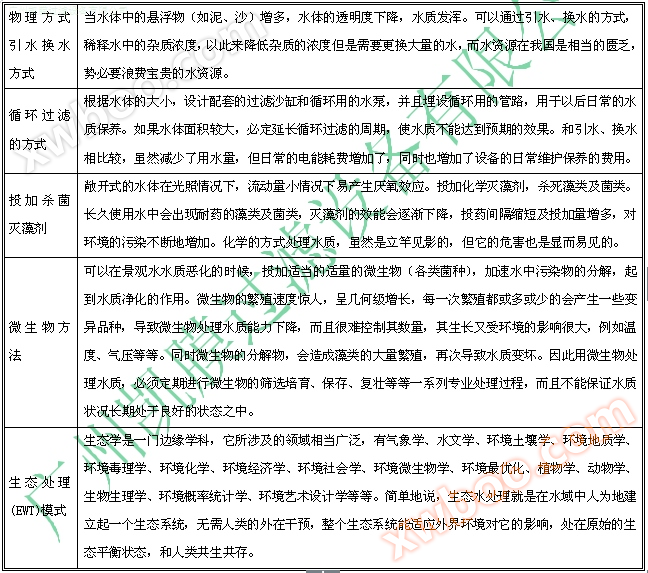
5. Comparison of various water treatment methods

6. Summary

The establishment of aquatic ecosystems is a slow process, gradually improving according to the status of ecosystem establishment. The research on the ecological theory of artificial lakes will have practical guidance for the treatment of wastewater in large public green spaces, low-density high-end residential areas, and industrial areas. Moreover, the development of ecological theory for artificial lakes will provide a solution and direction for further controlling eutrophication of natural rivers.