-
E-mail
hblhg @163.com
-
Phone
+86-13392495516
-
Address
101, Block A, Building 4, Huachuang Industrial Park Phase II, Panyu District, Guangzhou City
Product Categories
Guangzhou Kaimo Filtration Equipment Co., Ltd
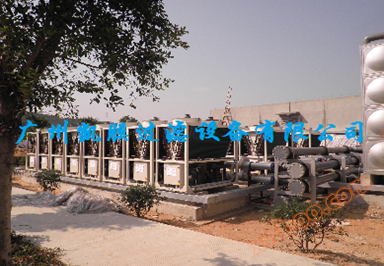
Swimming pool (bath) with constant temperature and humidity
NegotiableUpdate on 03/25
- Model
- Nature of the Manufacturer
- Producers
- Product Category
- Place of Origin
Overview
In recent years, with the rapid development of China's economy and the improvement of residents' living standards, a large number of communities and municipal facilities have public swimming pools. According to regional and seasonal differences, supporting public swimming pools are divided into indoor and outdoor parts, with a distinction between constant temperature and non constant temperature. Our company adapts to industry needs and undertakes all public swimming pool constant temperature, constant humidity, and water purification projects
Product Details
Swimming Pool (Bathing) Constant Temperature, Humidity, and Circulating Water Treatment

In recent years, with the rapid development of China's economy and the improvement of residents' living standards, a large number of communities and municipal facilities have public swimming pools. According to regional and seasonal differences, the supporting public swimming pools are divided into indoor and outdoor parts, with a distinction between constant temperature and non constant temperature. Our company adapts to industry needs and undertakes all public swimming pool constant temperature, constant humidity, and water purification projects.
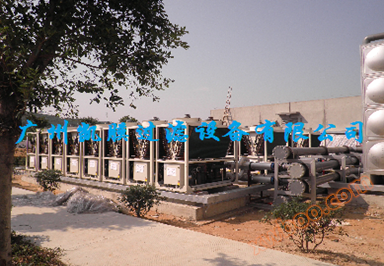
1.Swimming pool, bath with constant temperatureengineering
Swimming pools and bathing facilities mainly use heat pumps to provide thermal energy for constant temperature heating, with auxiliary electric heating, hot water or steam heat exchange. They are mainly suitable for indoor swimming pools. Heat pump technology is a new energy technology that has received much attention worldwide in recent years. "Heat pump" is a device that can obtain low-grade heat energy from air, water, or soil in nature, and provide high-grade heat energy that can be used by people through electricity.
The types of heat pumps include water source heat pumps, ground source heat pumps, air source heat pumps, and dual source heat pumps (a combination of water source heat pumps and air source heat pumps). Suitable heat pumps are selected for constant temperature heating according to the needs of swimming pools or bathing areas, seasons, venues, and other factors. Relevant circulation pipelines, water pumps, and auxiliary heating systems are also provided. The main parameters of the design process are shown in Table 1:
Table 1
Competition swimming pool |
Training swimming pool |
Diving Pool |
children's swimming pool |
Bath insulation water tank |
24~26℃ |
25~27℃ |
26~28℃ |
24~29℃ |
50-55℃ |
Note: The water temperature of swimming pools attached to communities, hotels, schools, clubs, and villas can be designed according to the training pool water temperature values.
2.Indoor swimming pool dehumidification project
Table 2
Room Name |
Indoor temperature (℃) |
Relative humidity (%) |
fresh air volume |
room noise |
||
Summer ℃ |
Winter ℃ |
summer |
winter |
(m3/h.p) |
(Standard NR) |
|
Swimming Pool |
29 |
29 |
60~65 |
60~65 |
30 |
≤50 |
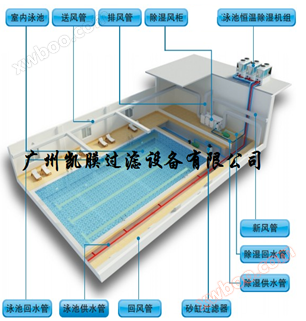
After the water temperature in the indoor swimming pool remains constant in a closed space, a large amount of water molecules evaporate from the water surface, causing the indoor air humidity to become higher and the comfort level of the human body to decrease. It is necessary to remove water molecules from the air without reducing the indoor temperature, so that the humidity and temperature in the air remain constant within the comfortable range of the human body. Conventional central air conditioning can only provide a small amount of dehumidification or constant temperature. Therefore, it is necessary to combine the swimming pool with cooling and heating air conditioning for specialized dehumidification. The main parameters of the design process are shown in Table 2.
The working principle of a dehumidifier is that firstly, warm and humid air flows through the evaporator, and the temperature drops. Warm water condenses into cold water and separates it from the air, making the air dry and achieving the dehumidification function of the air; The heat energy released during air cooling, water vapor condensation, and cooling processes is absorbed by the refrigerant. Part of the heat passes through the reheater, heating and cooling the indoor air to achieve the heating function of the air, as shown in the figure on the right.
3.Swimming pool circulating water treatment
The swimming pool water quality treatment system follows the principle of dynamic equilibrium and achieves thorough purification of water quality during the circulation treatment process. The swimming pool water is collected through the overflow channel and collected in the balance pool. It enters the circulating water pipeline together with the supplementary water, and flows through the hair collector driven by the circulating water pump to filter out hair and larger particles and debris; Then enter the automatic flocculant addition system; The system controls the precision metering pump to accurately add a flocculant aluminum sulfate solution (10% Al2 (SO4) 3) in proportion to the circulating water pipeline, promoting the coagulation of small substances in a gelatinous state in the circulating water into larger flocculent particles, which are then thoroughly filtered out by a quartz sand filter; The pH automatic adjustment system compares the measurement signal of the pH measurement sensor with the set value, and the microcomputer performs PLD operation on the difference to issue control commands. The precision metering pump injects dilute hydrochloric acid (10% HCl) into the circulating water to control the acidity and alkalinity of the swimming pool water within the national standard range (pH=7.0-7.8) "Swimming Pool Water Quality Standard" (CJ244-2007); The final disinfectant automatic adjustment system uses residual chlorine sensors or redox potential sensors to measure the disinfection and sterilization ability of the swimming pool. The controller controls the metering pump to accurately add sodium hypochlorite disinfectant (5% NaClO) to maintain the residual chlorine concentration in the swimming pool water within the national prescribed range (0.3-0.6ppm), effectively killing various bacteria and completing purification and disinfection.

Similar Product Recommend