- Phone
-
Address
No. 792 Dongguan Road, Muping District, Yantai City
Product Categories
- Peel residue distillation unit
- Preheating single kettle distillation unit
- Ancient Heavenly Pot Brewing Equipment
- Single pot distillation unit
- Solid liquid single kettle distillation unit
- Modern grain wine brewing equipment
- Essential oil/hydrosol distillation equipment
- 25L solid-liquid distiller
- alambic charentais
- Three-step distillation apparatus
- Continuous distillation equipment
- Solid liquid double kettle distillation unit
- Whiskey/Vodka/Rum Distillation Equipment
Yantai Jixun Brewing Equipment Factory

alambic charentais
NegotiableUpdate on 05/11
- Model
- Nature of the Manufacturer
- Producers
- Product Category
- Place of Origin
Overview
The distillation process involves injecting filtered wine into a still and boiling it until it boils
Product Details

distillation process
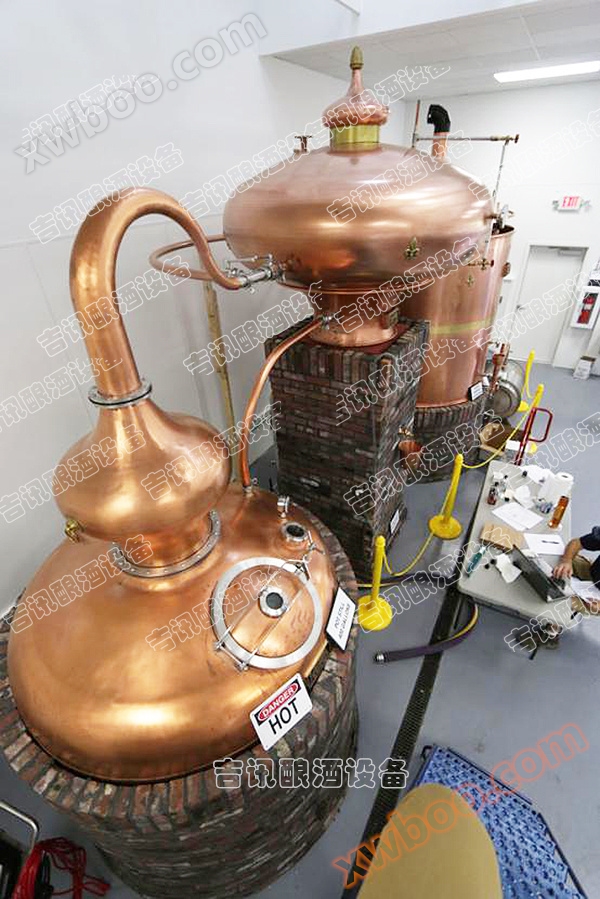
Pour the filtered wine into a still and boil it until it boils. The liquor vapor accumulates in the reflux device, producing a small amount of reflux distillation. It enters the serpentine tube through the "swan neck" and condenses out in the condenser, resulting in a primary distillate called "crude liquor". The original liquor is over 30 degrees and the distillation time is about 8-12 hours. Re add the raw liquor from the first distillation to the still for a second distillation, resulting in a secondary raw liquor with a typical alcohol content of around 50-75 degrees, with the remaining being the tail. The distillation time is approximately 8-12 hours.
process characteristics
1. The distillation time is long and requires two distillations.
2. The first distillation yields "crude wine" with an alcohol content of around 30 degrees, while the second distillation yields the original wine with an alcohol content of 50-75 degrees.
3. The time for one distillation is about 8-12 hours, and the time for two distillations is about 8-12 hours.
4. The water consumption is high. Taking a 1000 liter still as an example, the 6-minute inlet pipe is used for water cooling, with a water consumption of about 1 ton per hour. The first distillation consumes about 8-12 tons of water, and the second distillation also consumes about 8-12 tons of water. Generally, the cooling water needs to be turned on for cooling when starting distillation, and it needs to be turned on for cooling after the liquor is discharged. When the distillation is completed, it should be turned off.
5. The fruit flavor is a light aroma.
6. The consumption of heat and energy is relatively high. Taking a coal-fired boiler as an example, it takes more than 100 pounds of coal (theoretical data) to boil 1 ton of fermentation broth in 1 hour. The coal consumption for one distillation is 800-1000 pounds or more, and the water consumption for the second distillation is also 800-1000 pounds or more.
7. It is necessary to pinch off the head, middle, and tail of the wine, which is cumbersome and difficult to master.
8. There are many impurities in the quality of the wine.
9. After each distillation, there is always a tail. If the distillation is not good, it is usually discharged when it reaches 5-20 degrees depending on the situation, resulting in waste of raw materials.
10. Long term distillation leads to the breakdown of beneficial substances.
11. A successful distillation process lasts approximately 24 hours and requires the supervision and close monitoring of the entire process by distillation technicians, each with extensive experience and skills
One distillation: 1-2% of the original brandy has a total alcohol content as the head fraction, containing sharp aldehydes, esters, and alcohols, which should be discarded.
Secondary distillation process for extracting liquor: 1-2% of the original brandy has a total alcohol content of the head fraction, which contains sharp aldehydes, esters, and alcohols that should be discarded. Immediately take 30% of the volume, which means the alcohol content of the distillate is above 55%, and use it as a medium distillate for brewing brandy. Below 55% is the final fraction. The alcohol content of the distillate is 55% -20%, which is a secondary distillate used for brewing second grade brandy. The liquid containing less than 20% alcohol is called fragrant perfume, which is used to prepare the taste. Actual production can be as low as 5% distilled liquor, or secondary brandy can be obtained by distilling the distillate again. Definition of aromatic perfume: during distillation, the tail distillate with 20-0% alcohol content in the distillate is intercepted.
12. Using a pot still for distillation is a very complex process that requires batch by batch distillation, and the distillation efficiency is relatively low. To obtain very pure high concentration distilled spirits, two or even more distillation processes are required. However, regardless, it is often difficult to ensure the purity of the distilled liquor obtained by using a pot still for distillation. Low alcohol content, impurities in the wine, very rough taste, requiring secondary distillation
Distillation is carried out twice in the still, with two separate heats. The main advantage of the Charente still is the unique design of the gooseneck cap, also known as the column head, which is actually the cover of the distillation pot. One purpose is to prevent the phenomenon of "splashing the pot" during distillation, and the other purpose is to partially reflux the steam of the distillate, thus forming a slight distillation effect. Its volume is generally 10% of the distillation pot container. Gooseneck caps of different sizes and shapes have different distillation effects, and the quality of the products steamed is also different. Generally speaking, the larger the gooseneck cap, the greater the distillation effect, and the resulting product tends to have a neutral taste with reduced aromaticity. The Charente pot type distillation pot generally uses an "onion head" shaped gooseneck cap, but there are also "olive shaped" ones, but the latter produces products with lower aromaticity.
Product parameters

Control: manual/semi-automatic
Raw material: fermentation broth
Duration: Within 6-12 hours
Material: Copper+304 Stainless Steel


XLD2.8L

XLD5L/10L


XLD60L

XLD200L
XLD1000-5000L


