-
Phone
17719888549
-
Address
200 meters south of the intersection of Feilong North Road and Science Avenue in Xingyang, Zhengzhou, China
Product Categories
Zhengzhou Boiler Co., Ltd
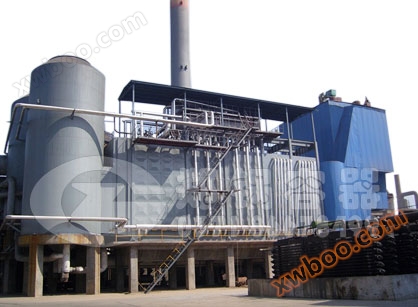
Vertical waste heat boiler
NegotiableUpdate on 08/18
- Model
- Nature of the Manufacturer
- Producers
- Product Category
- Place of Origin
Overview
The vertical waste heat boiler system is arranged vertically as a whole, with two passes of flue gas. The flue gas flow channel is in an inverted U-shape, consisting of membrane walls in the front, middle, and back. The middle membrane wall is a smoke barrier, and the left and right sides are light furnace types. The flue gas enters through the inlet and flows through the first convection evaporation section, superheater, second and third convection evaporation sections, and coal saving section in sequence before being discharged from the furnace. In this process, the heat in the flue gas is sequentially transferred to the water in the evaporation section and the steam in the superheating section, causing the steam to overheat. Finally, the remaining heat is transferred to the coal saving section, where it is preheated and enters the feedwater in the drum. The natural circulation system of the entire waste heat boiler equipment is equipped with a centralized downcomer. The centralized downcomer is connected to the lower header of each convective evaporation section, and the upper header of each convective evaporation section is connected to the drum through a steam connecting pipe. Due to the vertical arrangement of the boiler, the water circulation power is relatively large. Vertical waste heat boiler is a system that solves the problems of traditional furnace type with multiple flue arrangements, inconvenient setting of multiple flue gas return blowing, high system resistance, and the use of dispersed downcomers compared to horizontal waste heat boilers. In addition, adopting a membrane wall structure greatly reduces the weight of the entire furnace body and lowers the basic investment. Due to the less turning of flue gas in the flue, the flow resistance of flue gas is low, which reduces the operating cost of the system. The use of centralized downcomers reduces the difficulty of system design and makes it easier to shorten the development cycle of new products.
Product Details
Working principle
The characteristic of a vertical waste heat boiler is the horizontal arrangement of heating surface tubes, which can be inspected internally by walking on finned tubes without the need for expensive and bulky scaffolding. This is a unique feature of a vertical waste heat boiler. In addition, all headers can be inspected from the internal flue without the need to cut the external furnace wall. Each joint box is equipped with an internal aperture surface inspection device, which allows for quick and convenient endoscopic inspection.
If there is a leak, repairing and replacing the heating surface tube is also a very simple operation. After identifying the leaking pipe, cut it open from both ends and easily extract it from the temporary opening on the furnace wall. Then, replace the pipe using the same method. This process can be completed in the shortest possible time. Due to structural layout reasons, tube replacement for horizontal waste heat boilers is almost impossible to complete. Therefore, vertical waste heat boilers have unparalleled advantages in maintenance and repair.
Performance characteristics
1. The simple "three-dimensional" expansion design of a vertical waste heat boiler gives it great flexibility and allows for rapid start-up.
2. Small footprint. Due to the fact that all heating surfaces of the vertical waste heat boiler are vertically arranged in the flue, and the chimney is located at the top of the boiler, it greatly saves land area, which is particularly suitable for power plants with tight or expensive land prices.
3. Start quickly. Compared with horizontal waste heat boilers, the structure of the heating surface is that the two ends of the finned tubes are directly welded to the upper and lower headers, and each header is connected to at least two rows of pipes. Due to the different temperatures of the flue gas passing through the two rows of pipes, the wall temperature of the heating surface pipes is different, which will hinder the free expansion of the pipes. Or it can be said that its expansion is a "two-dimensional" free expansion. The start-up time of a horizontal waste heat boiler is generally 1:30 minutes for cold state, 75 minutes for warm state, and 45 minutes for hot state; The start-up time of a vertical waste heat boiler is generally 90 minutes for cold state, 50 minutes for warm state, and 30 minutes for hot state.
4. All the pressure parts of the heat exchanger in the vertical waste heat boiler are always manufactured in a modular manner, and these modules are completely assembled in the workshop. Although this increases the workload in the factory, it ensures the overall installation quality of the boiler and shortens the installation time.
5. Good sealing performance and minimal maintenance work. The sealing performance of vertical waste heat boilers is better than that of horizontal ones, with relatively fewer leakage points for flue gas and less maintenance workload.
6. High heat rate.
7. Beautiful appearance.
8. The preferred on-site solution for the carbon industry and cement industry.
Type
| project | LHS0.05 | LHS0.1 | LHS0.15 | LHS0.2 | LHS0.3 | LHS0.5 | LHS0.7 | LHS1.0 | |||
| -0.7 | -0.7 | -0.7 | -0.7 | -0.7 | -0.7 | -0.7 | -0.7 | -1.0 | |||
| M | M | M | M | M | M | M | M | M | |||
| rated evaporation | kg/h | 50 | 100 | 150 | 200 | 300 | 500 | 750 | 1000 | ||
| Working pressure | Mpa | 0.7 | 0.7 | 0.7 | 0.7 | 0.7 | 0.7 | 0.7 | 0.7 | 1.0 | |
| operation temperature | ℃ | 171 | 171 | 171 | 171 | 171 | 171 | 171 | 171 | 184 | |
| Rated feedwater temperature | ℃ | 20 | |||||||||
| thermal efficiency | % | 86-89 | |||||||||
| water capacity | L | 38.5 | 230 | 480 | 620 | 790 | 1100 | 1350 | 1600 | ||
| Steam outlet | mm | 25 | 25 | 25025 | 25 | 40 | 40 | 50 | 50 | ||
| water inlet | mm | 15 | 15 | 25 | 25 | 25 | 25 | 25 | 25 | ||
| drain valve | mm | 25 | 25 | 25 | 25 | 40 | 40 | 40 | 40 | ||
| safety valve | mm | 25 | 25 | 3 | 32 | 40 | 40 | 40 | 40 | ||
| power consumption | kw | 2 | 2 | 159 | 3 | 4 | 5 | 7 | 10 | ||
| Chimney | mm | 114 | 133 | 1030 | 159 | 219 | 219 | 300 | 300 | ||
| External dimensions | long | mm | 820 | 880 | 1030 | 1180 | 1350 | 1200 | 1250 | 1400 | |
| wide | mm | 820 | 880 | 2650 | 1180 | 1350 | 1200 | 1250 | 1400 | ||
| tall | mm | 1950 | 2150 | 1250 | 2520 | 2850 | 3150 | 3300 | 3650 | ||
| Transport weight | kg | 650 | 850 | 1250 | 1600 | 2600 | 2900 | 3300 | 3800 | 3980 | |
| fuel consumption | kg/h | 12 | 20 | 25 | 40 | 50 | 75 | 105 | 165 | ||


